Showing posts with label coups. Show all posts

Monday, December 8, 2025

Attempted Military Coup In Benin


Benin thwarted an military coup. Military coups are becoming more common across West Africa. The interior minister has reported that President Patrice Talon was safe. President Talon's exact location remains unknown. The administration did provide a statement. The coup plotters were condemned for disturbing the peace. A response from ECOWAS was to deploy soldiers. Forces from Ghana, Nigeria, Ivory Coast, and Sierra Leone are coming to support Benin's military. The concern with this relates to Benin's sovereignty and independence. Beninese are going to view such actions as occupation of their country. ECOWAS does not want governments like Burkina Faso, Mali and Niger. Africans are questioning institutions like ECOWAS, who at times as more of  an alignment to Europe and North America. All the coups of the 2020s are not revolutionary movements. Chad's coup was the assertion of the power of the Deby family. Little is known about the coup plotters. The name they give themselves is the Military Committee for Refoundation. This coup plot makes some more suspicious of the Beninese Armed Forces. Certain soldiers could be sympathizers with the Military Committee for Refoundation. Instability can cause intervention from neighbors and EU interference. The coup plot should be a reminder to the Beninese government to confront discord and corruption. Those grievances become the catalyst for military coups in African countries.      

Tuesday, December 2, 2025

Guinea-Bissau Falls To Military Rule


Guinea-Bissau has become another African nation to fall under military rule. The military coup was induced when disputes over the presidential election were escalating. The military asserted the coup was launched to prevent a deterioration of security. Election results were not announced. The error of opposition candidate Fernando Dias and President Umaro Sissoco Embalo was to claim victory before all votes were tabulated. Besides internal political discord, Guinea-Bissau struggles with foreign interference. Guinea-Bissau is a transport area for illicit drug trafficking. Drugs coming from South America are smuggled into the country and make their way to Europe. A series of coups continue to occur across West Africa and Central Africa. Corrupt governments and failures of liberal democracy have pushed militaries to act. All the coups are not revolutionary acts or objections to neo-colonial imperialism. While the coups in Burkina Faso, Mali, and Gabon were welcomed Guinea-Bissau is a different case. A number of  government institutions  are suspended and the electoral commission has done nothing to confront the junta. A prime minister has been appointed, but real administrative power rests with General Horta Ina-A. The military junta claims it will release the election results, but this could be a means of deflecting unconstitutional actions. Dias and Embalo are no longer in Guinea-Bissau. Fernando Dias accused President Embalo of inducing a self-coup. Little evidence exists of this claim and the junta made no further statements. Guinea-Bissau had military coups in 1980, 2003, and 2012. More coups could happen if  transition of power, electoral process, and the public are not respected. 

Monday, October 20, 2025

Madagascar Under Military Rule


Madagascar is now subject to military rule. Protests by youth groups caused the fall of President Andry Rajoelina. The head of state fled the country and this left a power void. Colonel Michael Randrianirina was in a position to seize power and it has been alleged that the High Constitutional Court invited him to do so. This leads to speculation that other parts of the government were plotting Andry Rajoelina's removal. The unit responsible for military rule is known as CAPSAT. President Andry Rajoelina was last seen departing on a French military  plane. He never officially resigned and claimed there were threats on his life. The 2025 coup was not the first military takeover of Madagascar. President  Marc Ravalomanana was deposed by a coup in 2009. Andry Rajoelina would take control of the High Transitional Authority being head of state from 2009 to 2014. The following period would be known as Madagascar's fourth republic. Rajoelina would be elected in 2019. It appeared as if he was a permanent fixture in the politics of the island nation. The error in 2025 was making an attempt to dissolve the National Assembly. The response from the governing body was to impeach the president. A military government is not going to stop protests. As long as power and water cuts continue demonstrations will increase. Corruption has cause much of the public discord and youth can no longer wait for gradual change. The African Union responded to the coup by suspending Madagascar. 

Thursday, May 22, 2025

The Ambiguous Condition In The Ivory Coast


Rumors of a military coup have come from Ivory Coast. So far, there is no evidence of an removal of the Alassane Ouattara presidency. Much of the unrest in the country comes from his desire to run for a fourth term. The Ouattara administration was the product of French invention in the Ivory Coast. The disputed election in 2010 saw the French install a government in the country. Pro-Ouattara forces arrested Laurent Gbagbo in 2011. Ivory Coast was experiencing post-election violence and what could be described as a civil war. Laurent Gbagbo was sent to Hague to be tried. It was clear this was political persecution disguised as fighting crimes against humanity. The charges were dismissed due to insufficient evidence. Egregious as this was, pro-Ouattara officials were never charged for banishing Gbagbo to the Hague. Gbagbo plans to run for president in 2025. There is a possibility that 2025 could be a repeat of 2010. The Economic Community of West African States are least likely to condemn Alassane Ouattara administration. ECOWAS is more aligned with EU political objectives, which explains its antagonism directed at the Alliance of Sahel States. Ivory Coast becomes more important to ECOWAS to counter Mali, Niger, and Burkina Faso. The condition of Ivory Coast remains unclear, yet the coming months will see increasing political turbulence.  

Thursday, September 12, 2024

President Alberto Fujimori Accuses Generals of Assassination Plot (1992)


Former President Alberto Fujimori passed away from cancer and  Peru remains divided about his legacy. Despite trials, questions remain about the extent of the criminal activity of his administration. Alberto Fujimori in 1992 accused some of his generals of an assassination plot. Doubts remain if these generals were actually attempting coup or assassination. Around April of 1992 Alberto Fujimori launched the self-coup. President Fujimori dissolved the Congress and the judiciary and the military assisted. It makes no sense that a military would help enact authoritarianism with a person they allegedly wanted to assassinate. During the self-coup a new Peruvian  Constitution was created. The reason for Peru's struggles were related to economic instability and the fight against the Shining Path. The accusation of an assassination plot was made in November around the time elections were restored. The image of a few rogue generals trying to depose the government scare people to vote. President Alberto Fujimori won reelection in 1995, but that would not have been possible with out the change to the Peruvian Constitution in 1993. The change allowed him to run for another term. President Alberto Fujimori never provided evidence of the assassination plot. Imposing authoritarianism was justified by the administration as protecting Peru's national security. What was happening was the government abusing power.   

Saturday, February 10, 2024

Imran Khan's Imprisonment


Pakistan is facing another political crisis. Imran Khan is now imprisoned on charges that observers believe has a political motivation. Removed from office in 2022, some would claim this was another coup. Pakistan has a long history of coups and Khan may have been victim to one. It is no coincidence that Nawaz Sharif has emerged. His intent is to form a coalition government. The Pakistan Tehreek -e-Insaf  Party is popular and polls predict a victory in the elections. Nawaz Sharif is favored by the military establishment and might intervene on his behalf. The Pakistan Muslim League needs a coalition to attain power. Even though other political parties and organizations are being suppressed, the PLM-N cannot assert full control. The Pakistan People's Party is also a major factor in elections. The two political dynasties which include the Sharifs and the Bhuttos are part of the political establishment. Keeping Khan imprisoned appears to be a means of stopping another political force emerging in the country. The Supreme Court should provide evidence and legal justifications for punishment. Otherwise Pakistan will resemble past military regimes . If Imran Khan were to be free, it is possible he could return to power. The military and Nawaz Sharif do not want him released, because Imran Khan would be a formidable political opponent. The dedication to the status quo has created more polarization in Pakistani society. Imran Khan's imprisonment is a reminder of how the military undermines the democratic institutions of Pakistan. 

Thursday, December 8, 2022

President Pedro Castillo Has Been Removed From Office


Peru is facing a constitutional crisis. When President Pedro Castillo attempted to dissolve the Congress, more discord emerged . The move was a way to avoid impeachment proceedings. His arrest does pose an issue. If impeachment proceedings never occurred and a formal removal from office never took place this could violate the constitution. President Pedro Castillo has been accused of inciting rebellion and constitutional violations. A trial has not been scheduled nor is there evidence at the moment of corruption. Dina Bolurate has been selected to finish up Castillo's term. That means she will be president until 2026. Peru's situation parallels Bolivia's political crisis. A left-wing president being deposed by right-wing opposition has become too common in Latin America. Leftist governments even though they are legitimately elected, they  are not allowed to rule. Peaceful and orderly transfers of power are disappearing. South America might be reverting to how it was in the 19th century. Extreme political factionalism,  erratic transfers of power, and authoritarian like political structures. According to reports, Castillo appeared to be making an attempt to leave the country. This indicates possible political persecution. Much of the discontent comes from an increase in fuel and fertilizer prices. This caused Peruvians to hold demonstrations. Farmers and lorry drivers were the most effected by the price rise. Imposing a curfew and a state of emergency reduced support for the Castillo presidency.    

Thursday, June 16, 2022

Former Bolivian President Jeanine Anez Sentenced To Ten Years In Prison


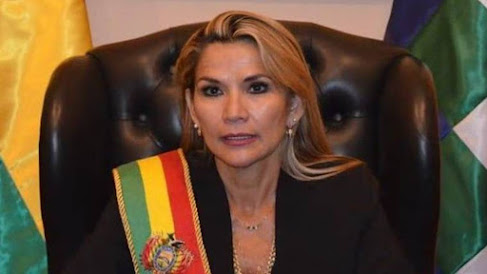
Jeanine Anez was sentenced to ten year in prison for illegally taking   power and violating the Bolivian Constitution. The accusations against Evo Morales committing electoral fraud were false, inducing a crisis. Morales' removal hints to a lager conspiracy. The right-wing political factions and the US organized a coup against his government. Anez claims she is innocent and a victim of political bias. Her argument was that she became interim president, because the nation was in such turmoil. The elections of 2020 were held, but it was clear the Bolivia became more divided. Jeanine Anez was unable to get elected, because too many people saw her as a conspirator. The Morales presidency did much in terms of poverty reduction and protecting the rights of the indigenous people. When Jeanine Anez served as interim president the Movement to Socialism Party found itself being suppressed. Anez is not the only one who had a role in the coup. While she remans in prison various sympathizers are active in both the government and military. Another coup could happen if such conspirators are not dealt with. The political crisis in Bolivia was reminiscent of the Cold War era. Right-wing political figures and the military would depose leftist governments. This was done with the assistance of the United States. Rarely do nations jail their former leaders. Even if they are sentenced, they will never serve its full length. Bolivia is now faced with growing corruption, the threat of coups, and those active in intrigue on the behalf of external forces. The progress made in the 2000s and 2010s might disappear. The arrest and imprisonment of Jeanine Anez will not stop Bolivia's challenges. What it demonstrates is a leader can be punished for egregious actions. Constitutional violations must be taken seriously to prevent Bolivia from becoming authoritarian.   

Wednesday, March 2, 2022

The Status of The Trial of Jeanine Anez


The former interim president of Bolivia is going on trial. She has been changed in being an accomplice in the coup that deposed Evo Morales. Currently, she is being held in prison before the trial. Anez has been there for a total of 11 months. The conservative leader claims she is a victim of political persecution. There is a strong case that she illegally assumed the presidency, which would be a constitutional violation. Other charges include violence directed at the public. Jeanine Anez was not elected she declared herself president in 2019. Losing the elections in 2020, it was clear Anez was not a popular public figure. President Morales was not removed by legal means. He was forced to go into exile in Mexico. The claims of electoral fraud from the OAS report have been questioned regarding Morales' fourth term win. So far, there has not been evidence found that there was electoral fraud in the Bolivian 2019 election. That means the legitimate government was overthrown. Based on this information, Anez would have difficulty proving innocence. Combined with the fact that violence was directed at the indigenous population during the protests, more charges makes it a challenge for her lawyers. A narrative is being created that President Luis Arce is using the trial to strengthen his administration. The armed forces backed Jeannie Anez's seizure of power. Taking power by force and instigating violence are serious and should not be ignored. Whatever the outcome, this could further divide Bolivia. Currently, the trial is suspended. If found guilty, Jeanine Anez faces up to 12 years in prison.   

Wednesday, April 14, 2021

Blaise Compaore Charged With The Murder of Thomas Sankara


The former president of Burkina Faso has been charged with murder. Campaore deposed the revolutionary Pan-Africanist leader Thomas Sankara in 1987. Campaore would remain in power until 2014, when he was removed by a mass uprising. Since then, he has lived in exile. Sources claim Blaise Compaore remains in Ivory Coast. There some indications that he wanted to make a return to the country. The country has in recent years undergone turbulence from insurgencies and terrorist organizations. The charges are complicity in the murder and undermining state security. Campaore was most likely more involved in the assassination than previously thought. The former president denies the charges and if he does return will fight them in court. Ivory Coast will not extradite him. Former authoritarian leaders have in the past avoided punishment for crimes in the past, However, some have convicted. Hissene Habre of Chad  was arrested in 2016. Blaise Campaore may be able to escape trial or prison. He has the benefit of protection. Unlike the ICC, which has questionable legitimacy this tribunal is the product of Africans. If Burkina Faso is to punish leaders it should be done under their legal system, not an international one. Blaise Campaore  although out of power still has relevance in the politics of Burkina Faso. His trial will allow for a tragic chapter in Burkina Faso's history to be closed.