Showing posts with label Social Issues. Show all posts

Saturday, August 20, 2022

Anti-Government Protests In Sierra Leone


The rising cost of living has brought people to protest in Sierra Leone. This resulted in a violent response from authorities. Freetown imposed a curfew. The price of food, gas, electricity, and various commodities  have pushed the country to the brink. Poverty has been a major concern. Some are calling for President Julius Maada Bio to resign. Yet, he insists that the protests were politically motivated. That argument does not explain the fact that inflation has not been addressed. The growth of economic inequality only causes discord and violence in a nation. Sierra Leone has been struggling to rebuild after a brutal civil war. The war lasted from 1991 to 2002, but the nation remains divided. ECOWAS has condemned the violence. This might prevent further escalation . ECOWAS did intervene in Gambia and that possibly could be another option for Sierra Leone. Economic improvements must be made before a civil war breaks out. If civil war does not happen, a possible military coup could happen. A combination of broken promises , lack of reconciliation, and economic decline  put Sierra Leone in this condition.  

Monday, August 17, 2020

New Zealand Will Delay Elections Due to COVID -19


Prime Minister Jacinda Arden announced that elections will be delayed at least until October. This is in response to the increase in COVID-19 infections. Observers thought that New Zealand had beat the disease and pandemic. Celebrating too early was a major miscalculation. Opening too soon as other countries have learned resulted in a wider spread of infection. While a new sense of urgency has come into the public consciousness, few have questioned the delay in  parliamentary elections . Delaying the elections would seem to give incumbents an advantage otherwise not present under normal circumstances. If New Zealand has a fully operational postal service, casting votes should not be an issue. The only problem would be ensuring that every vote cast is counted. The pandemic has finally resulted in one of the public's worst fears. World leaders will exploit the crisis to increase their power and gain unfair advantage. The political opposition the National Party also favors delays in elections. Judith Collins has went as far as to suggest making the elections be held in November. Being the leader of the opposition, there should be at least some alternative. The country enacted some of the strictest lockdowns and still are struggling with the pandemic. This should not be tolerated by citizens who want to vote and value the democratic process. Other countries such as Uganda and Vietnam have used COVID-19 as an excuse to limit freedom of their populations. Both Democratic and Authoritarian regimes use the pandemic to gain more political power.  

Wednesday, May 13, 2020

There Was Never A State of Global Normalcy

The COVID-19 pandemic has drastically changed life around the world. It has made people wish for some type of normalcy. The illusion is that there was some form of stability. Global normalcy is a myth. War, poverty, economic instability, and a general decay of society was prevalent before the pandemic. The notion that nation-states are acting as guides in global crisis is shattered with the continued deaths and increasing infection rates. Some have been insulated in bubbles, without recognition of the extent of human suffering. The common maxim "we are all in this together" shows a level of delusion that the public has. Disproportionately the elderly, discriminated ethnic groups, and the poor are effected the worse by the pandemic. These groups were already at a disadvantage in society. The crisis just exposed how they are isolated and marginalized. The calls for unity are only statements as international conflicts and disputes continue. The US, Russia, and China are still in a struggle for geopolitical dominance. Iran and North Korea remain under sanctions. The constant state of conflict and animosity was never normal. The developed world has been protected from some of the erratic events of the globe, but this could be coming to an end. Neoliberal capitalism has put the average person in a condition of financial vulnerability. Unemployment and a weakened social safety net will certainly cause civil unrest. Global normalcy and the international order have been set into disarray. The world will never be the same and does not appear to be progressing to a better future. Stability  never a part of the world.Once the pandemic has ended, there will be more contention and division among nations. Previous global issues and disputes could escalate. World history is an extensive documentation of armed conflict, economic struggle, and unrest. Global normalcy was a concept designed to create the illusion of stability and international order.
      Warfare continues unrestrained despite the international crisis. Iraq, Afghanistan, Syria,Libya, Somalia, Yemen,  and the DRC remain in states of conflict. Israel has not softened its aggression either, with plans to expand settlements underway. There are even attempts to depose legitimately elected governments. Venezuela could be facing a possible US attack or regime change by the Trump administration. It has been alleged that mercenaries were sent to induce a coup against President Nicholas Maduro's government. The US and the right-wing governments in Latin America are attempting to remove socialist or leftist governments either by direct force or  covert action. Warfare has become a normal part of the international stage, with various nations planning massive conflicts. China and Russia have been demonized to distract from internal problems of the EU and US. The reason conflict is encouraged has to due with economic and political factors. The arms trade would not exist if it were not for armed conflict. The business of building tanks, guns, aircraft, and naval ships is too profitable. The United States, Russia, the UK, and Germany have invested too much in arms exports. The world has never been in a general state of peace. Politically, the democracies of the West do not have anything to offer the public in the face of economic collapse. Politicians rather not embark on ambitious reform or programs to address social and international problems. Instead a tactic is to use scapegoating and fear to direct public anger at another country or race. The COVID-19 pandemic will inevitably make the world blame China. The disputes related to trade and geopolitics could result in war. Analysis have described a new Cold War between the US and China, but the tension seems more critical. The 20th century saw devastating conflicts such as World War I, World War II, the Korean War, and the wars in Indochina. There was hope that with a newly established United Nations, that international disputes could be solved without violence. Once more, world power politics continued to be the mode of operation. During the Cold War it was two superpowers in competition for global influence. When the Soviet Union collapsed this cause a dramatic change. The US was the sole superpower . As old ethnic and religious hatreds emerged in a changing world, so did the mass migration of people. Internationalism and globalism is being rejected in favor of a more rabid xenophobic nativism. The world is not one; it is nations fighting one another. Unity among humankind it is impossible as long as people cling to their national, racial, and religious hatreds. The fact that conflicts have continued despite the global pandemic is proof of this.
        Economic insecurity has been a constant menace to various nations of the world. Neoliberal  capitalism has failed to produce prosperity for the majority of the world's population. Under such strain, income inequality and poverty will only get worse. The only logical conclusion that can be made is that the capitalist system no longer works. The only reason to attempt to salvage such a system is because no clear  alternative exists. Socialism could be a solution to such problems, but world revolution is out of reach. There are numerous political, social, and regional circumstances that prevent such an event from emerging. At the most basic level, the world population has not reach a level of consciousness to do so. The world's poor have no power. Even in the liberal democracies, the politicians and legislators favor the elite. The average citizen has less influence compared  the corporations who largely finance certain political figures and organizations. Poverty can no longer be hidden with more people requiring food stamps and unemployment assistance. The global economy has bee erratic since the Great Depression. The stock market crash in 1987, the Asian financial crisis in 1998, and the 2008 global financial crisis are just a few examples in recent history of economic instability. The pandemic is not to blame for the sudden economic crisis. This was the inevitable result of supply side economics, deregulation of banking, and neoliberal economic policy. The concern was about economic growth and accumulation of profit. Stagnant incomes or decline in the standard of living was not the concern of business leaders or economic advisors. Social mobility has become more out of reach for the majority of workers, while others fall from a position of financial security. Workers have been struggling for one decade to the next, with little help. While a select few at the top of the social scale have seen more wealth, that was taken as a sign everyone was doing well.  The illusion was shattered and the world grows evermore restless. Class oppression, which was seen as normal is now being challenged. Human history since the rise of civilization has been be pyramid structure of social hierarchy . Oppression is not a normalcy, rather it shows the level of dysfunction in a society. A new distinct conflict is emerging, which is based around class.For most of human history this has been happening, yet now it has become even more pronounced.Economic  recovery may never come,but for most it did not materialize. The myth of economic security has come to an end and world governments do not have a proper response.
         A combination of  erratic world events has created social decay. The largest example is the inadequate amount of healthcare the average person receives. Countries with functioning healthcare systems are able to handle the pandemic better. Before countries that are reliant on private insurance have caused much distress to the public. Insurance basically decides what type of care a person  receives or whether or not a person get care at all. Developing countries struggle to maintain a basic healthcare system. Connecting business with healthcare only shows how corrupt society has become. Profit and business is more important than human life. This may only be an extension of other negative attitudes. Racial animosity is on the rise, with immigrants being used as scapegoats. Hate groups, fringe organizations, and far-right extremists are becoming politically acceptable. Out of fear and hate they are being embraced by a public that is vulnerable to propaganda. The social decay that is happening was not sudden. This was a gradual deterioration of communities. Globalization and partisan politics cause massive division around the world. Instead of  expanding opportunity governments added to social decay. Public programs and services were being dismantled in favor of privatization. Along with unfair tax codes and the disappearance of high paying jobs, poverty increased. The developing wold had been dealing with economic challenges since independence from former colonizers. The 2008 global financial meltdown saw Europe impose the most stern measures of fiscal austerity. Generations may never experience comfort or stability like they did in the past. As the elite gain more wealth and power, it becomes more apparent that conventional means of political participation cannot stop them. The anger and frustration has become too enormous to placate. Civil unrest could be a possibility, if there is not some way to combat social decay.
        The current world crisis has exposed many faults with humanity. Prejudice, suspicion, hatred, and scapegoating have been prevalent. The calls for unity are mostly disingenuous coming from the US-EU block. Sanctions are still being imposed on Cuba, Venezuela, Iran, and North Korea. Discussions of aid or assistance has been non-existent for these states. There are some people in society that are not deemed important, but contradicts the mythical narrative that humanity is fighting all together one of the worst crisis of the century. African Americans, Latinos, and Native Americans are dying at higher rates from COVID-19. Medical neglect demonstrates that the US does not care about citizens are are not white. The most egregious aspect is that spurious claim has been accepted that these ethnic groups just do not take care of their health. The elderly also are seen as low priority with retirement homes facing high rates of infection. These cases of abuse and neglect were common even before the pandemic. Normalcy was never a part of the world. There is talk of  times being unprecedented or turbulent. History has been a narrative of violence, unrest, and dramatic social change. Wars, revolutions, and civil disturbance were common. The difference now, is that more people are taking note of  this cycle unrest. Technology has allowed greater access to information and the ability to document events as they happen. The promotion of blind optimism or the false sense of unity is designed to keep the population passive. World civilization is going to be changed an extreme fashion and it may be difficult for people to accept.The ruling elite want to maintain the economic and political status quo, but a growing number of people will question it. So much so that the mechanisms of liberal democracy will be subject to scrutiny. The international order of the 20th century has officially collapsed. A new world has emerged and the concept of global normalcy has come to an end.            

Wednesday, August 7, 2019

Toni Morrison on Racism


Toni Morrison (1931-2019)  explains in a Charlie Rose interview about the psychology of racism. The desire to feel superior to another group is a behavior that has been a part of the American societal landscape. The melting pot only applied to white immigrants such as Germans, Italians, and Irish. African Americans, Asians, and Latinos were excluded from the wider American society. African Americans had a more harsh experience being kidnapped and enslaved to perform forced labor. The Native American experience was one of  genocide and cultural destruction. Toni Morrison however, states "I refuse to be a victim." Morrison delineates that racism can harm both the oppressor and the persecuted. To extent this is true,but the one with the power is only harmed in the sense that it distorts their reality. It does not result in death or discrimination. Toni Morrison then articulates that racism is a problem of white America and one that they do not acknowledge or attempt to understand. Morrison then discusses the delayed justice in the 1992 Los Angeles riots. The assault by Rodney King by police officers sparked a revolt by the African American community frustrated by constant abuse. The restraint shown by the community all those years was incredible considering the acts of violence directed at African Americans both past and present. Morrison's novels explored human faults and hatreds which became an inspiration to a generation of writers.  

Wednesday, July 10, 2019

Carrie Lam Declares the Extradition Bill Is Terminated and Protests Continue.


Carrie Lam stated "the bill is dead" while protests continue with no end in sight. The Chief Executive of Hong Kong faces a political crisis, which may become an wider problem for the People's Republic of China. The extradition bill would have seen residents of Hong Kong tried in mainland China. The fear is that a person would not get a fair trial for a certain criminal offense. Some believe that the law was designed to target dissidents who were either against Beijing or the Chief Executive. The sudden change in law and policy has created friction even outside of China. Boris Johnson who seeks to become Prime Minister in the UK has made comments in support of  the protests. This was followed by swift condemnation from China. Ever since Xi Jingping became core leader, his presidency has sought unity through crackdowns and a limited toleration for protests. Instances of police brutality forced Carrie Lam to make an apology for poor conduct. Gradually calls for her resignation became louder, but there is a fear that she could be replaced by someone more stern in approach. The former British colony was transferred to China in 1997. Ever since, there have been cases of civil disobedience. The current protests seem different with participants demanding more. Escalation could lead to serious violence, but Beijing may not be will to use force against Hong Kong. The memories of Tiananmen Square still remain with some government officials. Although China has proclaimed this is domestic affairs matter and no nation has the right to interfere, drastic action could change global public opinion. The situation is a delicate balancing act between the people of Hong Kong, Carrie Lam, Xi Jingping, and the question of the law.   

Wednesday, May 29, 2019

Former President Blaise Compaore Offers to Return to Broker a Peace Deal


It was in 2014 that Blaise Compaore fled Burkina Faso. Now he is offering to comeback to the country to negotiate a peace deal with armed groups fighting the government. To an astute observer, this is not about making peace, rather Compore's attempt to return to power after five years in exile. He came to power in a coup in 1987, which resulted in the murder of Thomas Sankara. Now it appears he once more wants to seize power by extralegal means. This may not be the most successful plan, yet there is another alternative he is using. Writing a letter to President Roch Marc Christian Kabore he offered to help with reconciliation efforts among warring parties. President Kabore and hsi government have no intention of making peace with armed groups. Allegedly the Islamic State of the Greater Sahara is active in the country and other bordering states. This may explain terrorist attacks that have occurred recently in Burkina Faso. Dicko Oumar  a Burkinabe politician, makes the statement that when Compaore was in power such problems did not exist. The challenge of removing a longtime leader is what happens afterwards. The negative effect of deposing authoritarian presidents is that instability and insurrection occur in a power struggle. Compaore has connections and negotiation skills which did allow for the release of hostages in Mali. So far, there is no plan for securing his return to Burkina Faso. Others want him to return for another reason. Some desire to see Blaise Compaore stand trial for his human rights abuses during his presidency. With elections only a year away and growing violence politicians are going to struggle to gain support of the citizens of Burkina Faso.      

Tuesday, May 7, 2019

South Africa Votes


South Africa will be holding its general election on Wednesday May 8, 2019. The ANC may be having its biggest challenge yet, with a public dissatisfied with corruption, economic struggle, and a general lack of equality for all citizens. Poverty, xenophobia, and the need for land distribution are issue that can no longer be ignored. Cyril Ramaphosa president of South Africa and ANC  candidate has attempted to address corruption, but he may be blocked by the remaining Jacob Zuma faction. President Zuma's fall from grace had badly damaged the image of the ANC. Mmusi Maimane  of the Democratic Alliance hopes to gain the presidency and get his party more seats in Parliament. Julius Malema of the Economic Freedom Fighters has the most progressive  agenda calling for redistribution of wealth. It seems that South Africa has capable leaders who are eager to make changes. However, the question remains who among them are willing to confront the problem of white ownership of farmland and industry in South Africa. The black majority needs economic power, which they were deprived of under Afrikaner rule.   Which ever party or candidate South Africa votes for, it should be a person who meets their needs. Above all it should be a leader will to do what is required to reverse half a century of Apartheid and injustice. Sustainable economic growth should be a priority as well as improving South Africa influence in BRICS.   

Monday, April 22, 2019

The Terrorist Attack in Sri Lanka


Easter Sunday a series of hotels and churches were attacked  in Sri Lanka. So far, it has been claimed that  National Thowfeek Jamaath is responsible for the criminal acts. The government claims that there is a possibility that it is part of a much larger network. Very little evidence exists to suggest this. The death toll has been estimated to be about 200 people killed in the wave of violence. The unfortunate aftermath is that the government will begin to crackdown on civil liberties in the name of security.  Social media restrictions have already been put in place. A curfew has also been announced for the citizens of Sri Lanka. This follows a pattern that many nations that dealt with terrorism. Sri Lanka has dealt with war and violence before fighting a civil war between 1983 to 2009. This resulted in the defeat of the Tamil Tigers, but ethnic tensions still remain. Human rights violations during the decades long conflict have never been prosecuted. Prime Minister Ranji Wickremesinghe  was  previously in conflict with President Maithripala Sirisena. Political factionalism will on make the current situation worse discussing solutions to rising violence. There are indications that law enforcement knew of attacks, but took little action to prevent this event. The Asian nation will have to figure out how to deal with both terrorism and growing discontent from the public regarding intelligence failure. China and India has interest in the island nation, which may lead to Sri Lanka having bigger security ties to fight armed groups or terrorist organizations.   

Sunday, March 17, 2019

Prime Minister Jacinda Ardern Promises More Gun Control


The Christcurch Mosque shooting has caused Prime Minister Jacinda Ardern to propose stronger gun control. This act of  racist and Islamophobic terrorism has exposed a problem that rarely gets media attention. White nationalism and xenophobic nativist nationalism has become an international phenomenon. Hate has always been there and the historical legacy proves it. While the media presents New Zealand as a peaceful,open, and tolerant society the reality is its foundations are based on imperial conquest. The British just like in Australia displaced the native population. Maoris are strangers in a land that is theirs and immigrants face hostility from the white population. Social media and guns have been blamed fro this horrendous act of violence. Such explanations ignore the real issue. There is an reluctance to admit that the majority of European descended peoples do not want to share their countries with African, Asian, or Latin American populations. Many whites feel the sentiments uttered in the manifesto written by the shooter. Individuals may not act on violent sentiments, but the hate is there.  Prime Minister   Jacinda Arden may not be able to make meaningful change, if she does not address the violent racist history of New Zealand's past. If there is no serious discussion about racism among the majority of the white population in the Oceania region, acts like this may continue. As populations flee war and poverty, the more xenophobic nativist nationalism becomes popular among people who do not understand or fear demographic shifts. If the government does not act racist violence will become normalized.  

Monday, January 28, 2019

The Myth of Human Progress

Civilization and society has undergone radical transformation during the course of human history. The world changed from hunter gatherer societies to modern nation-states. There is a common conviction that the status of the human condition is improving. Some observers have even proclaimed this is the most peaceful era in history. This seems more to be a falsehood as there are more challenges confronting the world. The increase of ethnic, racial, and religious conflict has been exacerbated by political and economic events. Scientific advancement and technology has caused unintended consequences. The belief that stable communities can be formed has become unattainable. The lugubrious state of affairs demonstrate that the world can be made into something better is a fabrication. When the word progress is used to describe changes in human societies there is the implication that political, economic,and social conditions have improved. These comparisons of past and present are not evidence of an emerging golden age. There has been a shared concept among some scholars and observers that particular world problems of war, famine, disease, and human rights abuse would be relics of the past. This misguided vision bordering on utopian fantasy fails to realize history follows cycles of conflict and stable established order. States have been formed through warfare and geopolitical maneuvering from the ancient world to present. The prevalence of democracy, capitalism, and supranationalism  has not produced the type of world leaders and political science intellectuals had hoped for. The end of World War II and the Cold War there was a feeling that the world would become more unified under a banner of peace, cooperation, and a sense of universal justice. The result was a world with more geopolitical complexities and a reaction to an imposed globalism which has both economic as well as cultural  aspects. The same issues still plague humanity as they did in the past : war, economic instability, racism, and lack of food security. New problems also exacerbate the old ones which range from environmental destruction, the abuse of technology, and the consequences of overpopulation. The world has changed, but the current developments are not paradigms of progress. The myth of progress emerged from the idea that the future would be a spectacular apex in the development of  humankind. This vision has been slowly disintegrating under the pressure of rapid urbanization, political shifts, and sociocultural change.
      The major shift in human history was the change from hunter gatherer societies to permanent settlement. Normally,scholars cite this development as a positive change for humanity mastering agriculture, domestication of animals, and the rise of  cities. There were certain consequences that occurred that are still present in the contemporary time period. Property became a mark of status and power. The class divide began with those who owned land and farming settlements. Those who were still hunting and gathering were at a disadvantage. The permanent settlements became  powerful by generating surpluses which gradually led to the exchange of goods and services through currency. Prior to uniform currency, societies functioned on a system of bartering.


The group with the most resources would have more influence and control compared to those living in a nomadic lifestyle. This change that occurred also altered the nature of gender relations. During the hunter gatherer stage of humanity men and women had an equal status. The rise of property and permanent settlement saw a sharp increase in society based around patriarchy. Men would have control of land and property with only rare occasions in which women were able to have access and own some. Men were groomed and encouraged to be leaders of society, while women were regulated to a solely domestic function.  Homo sapiens emerged around 50,000 B.C.E, but the Paleolithic and Neolithic Ages would redirect human history. The Paleolithic Age saw humanity make use of stone tools known as eoliths. While the crafting of tools became pivotal for survival it would have larger repercussions in the distant future. Microliths were the precursor to technological miniaturization. These flints were specialized for various uses. The Neolithic Age was the period in which humanity was able to control its food production. The peoples of the Fertile Crescent which was located in what is now the eastern Mediterranean  and part of  the Persian Gulf  saw the domestication of animals. Dogs and cattle would become essential to agriculture projects in the region. This was preliterate society. Writings were not present during this period. The Neolithic Revolution began around 8000 B.C.E and what has been uncovered by archaeology was that there was an early system of social stratification emerging. Catul Huyuk provides evidence of what preliterate society would have been like during the Agricultural Revolution in 6000 B.C.E. There is a position that speculates that preliterate societies in the region were  governed by a council of elders and all male assemblies contributed to decisions involving war or selecting a chief. It would be difficult to argue that the system was democratic seeing as women had little or no participation. The establishment of centralized government would cause problems between the governed and the leadership. 

The Agricultural Revolution has been seen as a form of progress by scholars of history. This shift to agriculture happened all around the world at different time periods. Humanity was able to feed itself for 2.5 million years, however this change had unintended consequences. The diet of humanity got worse and it further induced a wider gap among social classes. It caused population explosions that many societies had to deal with in a particular manner.The farmer became a privileged elite. Wheat and grains became symbols of power and prestige. This inevitably caused conflict between foragers and farmers for domination of land as well as plant resources. The foragers and the few remaining hunter gatherers fought a losing battle against the rise of the permanent village. Agriculture did not provide absolute food security. Crop failures could mean starvation for those reliant on subsistence agriculture. Framers were not more food secure than hunter gatherers or foragers. 


Agricultural revolutions thus spread across the world. It has been theorized that more areas could have had agricultural revolution, but archaeology has yet to prove there was more. Africa (3000 B.C.E),East  Asia ( 7000 B.C.E),  Oceania (6000 B.C.E), North America ( 2000 B.C.E), Central America ( 4500 B.C.E), and South America ( 3500 B.C.E)  saw transformation from the introduction of agriculture. Societies would thus be modeled on a pyramid structure with monarchs at the top, a warrior class, and a religious order. What started with permanent settlements gradually transformed into villages and then towns. Cities emerged when populations increased in a certain area. Large populations required a different type of  governing and political system.  
        The rise of cities allowed for the conception of empire. Sargon of  Akkad was considered to be the world's first large empire builder in ancient civilization. What fallowed was a dangerous path to permanent conflict. Soon every continent would have large empires. Rome, Egypt, Nubia, Kush  China, and Mesoamerican civilizations came into existence getting larger  through conquest. While these empires of Africa, Asia, the Americas, and Europe were different they had one common trait. Imperial ambition and war were the foundations of these states. Ancient imperialism denied many people freedom if they had the misfortune of being conquered. There were cases in which areas would just merely have to pay tribute rather than face complete subjugation. The Roman Empire had to do this to a degree to prevent mass insurrection. Particular negotiations had to be conducted to maintain vast amounts of territory. Ancient imperialism functioned around a city growing or region  in power and then  expanding beyond certain borders. A series of wars would be fought till it reached an immense geographic size. Decline would follow from either military defeat, internal political problems, or being conquered by a stronger power. The Mauryan Empire fell into gradual decline after Emperor Ashoka. The Roman Empire split into a eastern and western section. Rome faced attacks from Lombards, Goths, Visigoths, and various Germanic tribes contributing to its decline. 
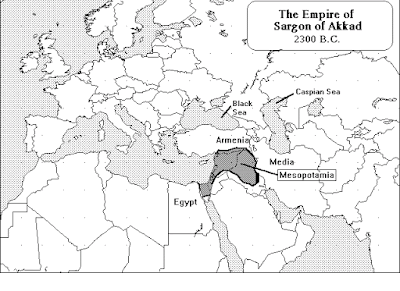
Warfare was not seen a something negative, rather a common part of  state affairs. This did not mean that peace was completely rejected when  an empire reached its apex. Such projects required a level of collaboration and powerful leaders. The ancient imperial projects could only function under a monarchy or emperor as the governing authority. Monarchy has been the oldest form of government. Democracy can trace its origins to Athens around 508 B.C.E being more direct in political function. All citizens had the right to come and address the Assembly. This was not truly rule by the people rather the nobles had control through their own council known as Areopagus. Athens was a city-state in classical Greece that was a rare exception. All over the world there were empires located near river systems governed by monarchs along with a ruling class. If such democratic systems been in place, ancient empire may not have  expanded in the  way that they did. The ancient and classical  empires did leave behind impressive structures, ideas, and knowledge yet it should be understood it came at a cost. The progress that scholars cite came at the expense of the lower classes and subject peoples. 


Empire building began to spread across the globe with numerous states appearing in Africa, Asia, and South America. There has been a common conviction among scholars of history that empire works seeing as it is a consistent theme that appears in world history. The British Empire has been discussed with nostalgic endearment. This emotion ignores that it was at least until World War II the most oppressive force in the international landscape. Contrary to popular belief empire and imperialism are not sustainable systems. They brought much violence, disorder, and fear to the victims of an empire's might. While the process was violent, at times it required collaboration from subject peoples. The Roman Empire would not have lasted long if it did not have willing cooperation from other groups that it conquered. The British Empire used a method of indirect rule with some of its colonies. India was a colony that required alliances with local leaders to assist British control of a vast subcontinent. Such control mechanisms require that particular groups are in confrontation with one another so they cannot united to free themselves from an empire. Belgians did this in Rwanda and the Congo realizing that Hutu and Tutsi conflict would work to their advantage. While empires can be oppressive to numerous ethnic groups or the entire population chaos follows with collapse. New states emerge and old hostilities carry over. The end of the Roman Empire gave rise to numerous tribes that attacked it to change the political landscape. What emerged was the Byzantine Empire and the  Holy Roman Empire, which were successors to Rome. Europe was in a period of the Dark Ages in which there was little advancement in the arts, sciences, or culture. African and Asian civilizations were not experiencing in their societies.  As time passed, the European empire gained an advantage in science and technology. The Enlightenment and the Age of Exploration propelled  Europe into a leading position among the nations of  Earth. 

The territories of the British Empire are in pink. This was the extent of its influence that ranged from Africa to Asia and areas in North America. 

There will always be conflict when empire emerges. The British, French, Germans, and Italians competed for colonies and influence around the world. Spain and Portugal were the main competitors in global influence during the Age of Exploration. These two powers were later surpassed by France and the UK. During the 19th century Germany and Italy became unified states changing the balance of power in Europe. It was only a matter of time before mass global conflict broke out. World War I lasted from 1914 to 1918 leaving Europe devastated and new countries forming out of that conflict. There was not satisfaction or clam, rather more political complexities in eastern and central Europe. Britain and France divided new territories among themselves under the mandate system. The collapse of the Austro-Hungarian, German, Russian, and Ottoman Empire caused a mixture of ethnic violence and confusion. The modern Turkish state made it clear that Greeks, Armenians, Kurds, and Jews were not going to be part of the national project. What drove empire was economic and political factors. It was a lucrative enterprise and it created a sense of unity among the mother countries. When empire collapses, there still remains the practice of international power politics in which various states compete with each other for economic,political, and cultural influence of the world. Neocolonialism is merely the product of a lost era in which certain nations could be aggressive and dominate countries which could not resist. The idea that empire works seems to lack cogency, considering the number of empires that have disappeared or have left instability in multiple regions of the globe. 
       The persistence of warfare around the world demonstrates that humanity has not made progress. Warfare may have even been part of early hunter-gatherer societies and became more a common activity with the rise of property ownership as well as permanent settlement. When the idea of permanent states developed along with more centralized governments, armies were needed to defend borders. Conflict was inevitable with these historical developments. The building of empires was not a peaceful activity. It involved subjugation of various people by armed violence. They only way this was kept under control was through international law and a modern system of treaties. Prior to World War I, there were the Hague Conventions building the groundwork for modern international law, rules of warfare, and early system of  supranationalism. After the Great War, the League of Nations was formed as an international body to promote peace and enforce international law. This body was not able to deal with the British Empire and France in regards to their abuses under the mandate system. It was unable to thwart the growing threat of Fascism or a more aggressive Japanese Empire. Low scale conflict finally merged into a larger one by 1939. With the defeat of Fascism in World War II the United Nations was formed to ensure that mass global conflict would never happen. However, conflict did not stop. The Cold War and decolonization became major sources of discord. The Korean War, the Vietnam War, and the Israeli-Palestinian conflict were causing much humanitarian crisis and erratic changes in both Asia as will as the Middle East. France and Britain were still unwilling to give their colonies independence and some had to get their freedom by armed force. Burma, Algeria, Vietnam, Zimbabwe, and South Africa had to fight armed struggles to remove their former imperial masters. The South African region was in long term conflict from the Rhodesian Bush War to the anti-apartheid armed struggle. When all these decolonization movements were occurring, the US and Russia were engaging in wars of proxy with one another getting more involved in the Third World. Wars were happening all over the globe in the 20th century and will still continue. The end of the Cold War did not bring lasting peace or stability. It formed a world in which US power when unchecked. Nations were subject to the whims of US power, but it seems that multipolarity is challenging that concept. The potential for conflict grows greater with Russia and China as long as US foreign policy attempts to antagonize these countries. 

The world powers need a system of peace for the sake of security. Yet, there remains too much profit in warfare. The military industrial complex has become an essential part of the economies of France, the US, UK, and Germany. Arms manufacturers have significant investment in seeing global conflicts continue. There may also be a more lugubrious reality in which the majority does not want peace. The democratic western societies have attacked states in the developing world. The arguments used are either based on humanitarian intervention or a national security measure. These states have smaller armed, no nuclear arsenals, and have less wealth yet are presented as dangerous threats. Iran and North Korea could not defeat America, France, or the UK in armed conflict. The motivations are different than what the citizens of the developed nations are thought to believe. War provides a perfect distraction from domestic problems such as economic weakness, crime, or corruption in  the political system. During times of war, the public is more united in fighting a common enemy. When politicians of the liberal democracies have failed to provide solutions to growing domestic challenges, there is an attempt to scapegoat a particular group or people. Despite the political conditions of a certain era, warfare has been a reoccurring part of human history. Many cultures and people around the world have had a tradition of warrior societies. Dahomey, Japan, and Sparta are a few examples of strict and regimented warrior cultures. As long as states and governments exist, there will be no peace on Earth. Humanity has a bullying and violent nature that has yet to be overcome. The reason why the peace movement or pacifism in general will not become a large force is that is against the public's instincts to support such ideas. The only time people en mass repudiate war is when their  country begins to lose. When there is nothing but triumph, then nationalist fervor cannot be contained. Ethical questions are not as important as strategic ones. Warfare has throughout history been an instrument to gain or expand power. Warfare's intrusion into multiple regions only makes the situation more precarious making it easier for conflicts to merge. 
           The myth of human progress also can be seen in the idea that this is a more tolerant era. Racism, sexism, class conflict, religious persecution,  and homophobia as some claim is not as awful as it was in the past. While this is a statement of fact, that does not mean these ills have disappeared. There are certain cases in which as been on the rise in response to economic and political factors.Besides current developments, prejudice can be present in societies for long periods of time. The contemporary era shows that people have more contact with various cultures, races, and religions yet this does not terminate extreme ethnic conflict. This does not prevent discrimination or persecution in nations around the globe. China continues to treats its Tibetan and Uyighur population as second class citizens. The United States not only is going through a phase in which white supremacy is seen as acceptable, other groups are targeted. Islamophobia and anti-immigrant sentiment has been spreading  on both side of the Atlantic. Russia has undergone a nationalist revival in response to a NATO build up. As a result non-Slavic peoples are viewed with suspicion. All around the world there seems to be ethnic conflict or some for of racism or persecution. The threat of genocide become more a possibility under a world in constant warfare. Xenophobic nativist nationalism has become a popular movement among the far-right and politicians in power to remake their nations into a homogeneous unit. The idea that globalization brings about tolerance or a greater understanding seems misguided. To an extent it enables cultural imperialism. Western culture has become more accessible and attractive to youth of the developing world. With its ubiquitous nature, the local culture seems to be either eroded or will be phased out as time goes by. There is not merely acculturation. There is a desire to have all nations westernize and simultaneously abandon what makes them culturally distinct. Such ideas are promoted by supporters of supranationalism and  a globalist political philosophy. The hidden ethnocentrism of the countries of Europe are demonstrated in their behavior relative to foreign policy. They blame a country's lack of development on the fact they do not westernize. Ignoring the legacy of  empire or the impact of neocolonialism only shows that racist ideology has not dissipated. 


More and more the people of the world have become extremely tribal in their thinking. Economic and social tensions are only exacerbating intolerance. Fear of demographic shift has driven voters in democratic societies to vote for people with authoritarian tendencies. Hatred does not just involve skin color it also includes political affiliation or culture. Religious fundamentalism continues to exist even when people live in a society of science in technology. Fanatic Christians, Muslims, and Jews justify their abuse or violence against people on the basis of their religion. Zionism and Islamism have generated both religious and ethnic hatred in the Middle East. The Christian right in the United States actively undermines women's reproductive rights. Organized religion and its hold over large numbers of people is not a sign of progress. There have been multiple times in history in which religious fanatics were involved in persecution or elimination of individuals who dared question the Church. If it were not for the Enlightenment, such behavior and legal codes would have continued. Extremists of this sort are so intolerant other religions they see as illegitimate. With wider conflicts occurring across the Asian and African continent, the world is far from being tolerant. If there was to be substantial change, attitudes must be altered. Tolerance may not be enough. Acceptance should be the goal with the understanding that different groups of people have the same rights and deserve equal treatment. Many observers have made the argument that under democratic political systems, such ills of hatred and prejudice can be countered. 
           Liberal democracy or capitalism  cannot be considered a measure of progress. Although state formation and building a political structure has always been an experiment it has not resulted in better lives for the people living in such states. This is not to say that an authoritarian or totalitarian  government is a reasonable alternative. Communism attempted to challenge the capitalist system and there remains some active socialist organizations. However, it has not become a major political force. The only attribute about liberal democracy and capitalism is it can survive. Other than that, it cannot meet the needs of the people. The illusion of freedom is that people have a choice in such political structures. The pyramid structure that has existed since civilization's origins still negates the powerless majority. Voting or non-conventional participation can only do so much to negate the power of a ruling class. Corporations, lobby groups, and political action committees have more influence over elected officials than the average voter. The parliamentary and presidential systems could potentially fail  by not addressing growing income inequality and the destabilization brought about by neoliberal capitalist policy. Democracy has a flawed system. It requires that all citizens participate, have equal access to that system, and that they have the ability to make informed decisions. The governments and citizens of the UK, France, Germany, and the United States fail to meet these requirements, which explain the current turmoil seen in those countries. There are nations that may have the structures of democratic government, yet behave in an authoritarian manner. Having the presence of multiple parties does not ensure a fair political system or an efficient one. 


India and Pakistan have to struggle navigating a multiparty system combined with both regional and ethnic complications. The end of the 20th century did not usher in an era of greater human freedom, rather a system of illiberal democracy. The oldest form of government was monarchy . That system was dominant up until the late 19th century to early 20th century. From the ancient world up to the early 20th century a political scientist may have believed that monarchy would be the only political system that humanity would adopt. An assumption like that would be incorrect. Certain political systems have not been experiment with. New ideologies emerge challenging the political consensus and order. There  has been the possibility of revolution that will dramatically change the cultural and political environment of a nation. Liberal democracy is nothing more than another political experiment that will not last forever. By nature it can be unstable and erratic. Capitalism puts emphasis on free markets and private enterprise. Supporters claim it can create prosperity and reduce poverty. It does create prosperity, yet not for the whole of the population. The ruling elite benefit the most while labor is exploited for the sole purpose of profit maximization. The developed world has witness a phenomenon of stagnant wages, fiscal austerity, and even longer working hours. The middle class and poor are forced to pay more in taxes in a supply side economic system, which has created growing tension. There are very few foundations for personal economic security. There can be a chance that a person could fall into poverty by no fault of their own. Economic and political systems should not be used as an indication of human advancement. No matter what political or economic model poverty and war still persist. 
          Science and its application has often been referenced as evidence of human progress. Applied science has produced many marvels. Biomedical and health science has combated disease as well as increased average life expectancy. The telephone and the internet make communication around the world far more simple. Space exploration opens up doors to places never thought to exist.  Technology has to an extent improved lives. It can be abused depending on how it is utilized. Nuclear weapons and their proliferation cause concern. The trepidation comes from the chance humanity's destruction will come at its own error. 


This was not the only technological advancement that shocked the world. Airplanes, tanks, and drones changed centuries of military tactics with their introduction. Warfare became more lethal. Technology and science have been viewed with a level of caution and fear. The unintended consequence of technological development was harm to the environment. Pollution, the burning of coal, and masses of  waste have cause permanent damage to the Earth. The world's population grows and the more it consumes. Electronic and plastic wage has become harder to dispose of. Climate change also poses a threat to the safety of  the world population. Higher carbon dioxide levels from fossil fuel use and automobile transportation exacerbate green house effect. The increased temperature causes the polar ice caps to melt gradually. The sea levels rise increasing the likelihood of flooding. The Earth's climate has changed throughout geological history, but this is the first time in which people contributed to this rapid shift. The industrial revolution transformed the environment of the world. Factories and machine power would soon replace manual labor. The world became more reliant on fossil fuels such as coal and oil. This desire for and intense consumption of fossil fuels devastated both land and sea. Besides what humanity has done to its environment, it is may be doing something similar with the body. Genetic engineering and transhumanism  are no longer science fiction. Last year the fist gene edited babies were born and it is not unheard of to seeing genetically modified organisms in supermarkets. Human beings have the ability to alter themselves biologically. If there is limited regulation or laws regarding this new scientific knowledge could be misused. Information technology has become a part of daily life. So much so, that privacy may be a relic of the past. Data protection and identity theft are becoming large concerns on social media platforms. The collection of data and surveillance by either governments or corporations violates privacy and civil liberties. Science and technology will continue to evolve, however it is pivotal that it must be used responsibly. Technology  did not make the human condition easier; it may have added more issues. 
      Human history has reached a stage in which more people live in cities, use technology, and live under some version of liberal democracy. There is the tendency to say that the current period is much better compared to the past. Progress has in this perspective a logical conclusion. The definition used in this context means that society and the human condition can improve for the better.   The myth of human progress is that someday civilization will reach a level in which war, poverty,  and oppression disappear. This utopian ideal does not acknowledge that history does not follow a direct line of advancement. Large empires and states have appear then vanished leaving behind artifacts of their golden age. There could be social, political, and economic progression yet this could all be eradicated  with a change in regime or circumstance. The African, South American, and Asian nations have long histories of  civilizations and empires. When the industrial revolution and the advances in modern science passed them by, they became colonized. Ethiopia and Japan managed to avoid this fate by making efforts to modernize and build an industrial capacity. The former colonized countries are now trying to reach a level prior to European contact. The march of humankind seems to be a never ending struggle. There are cycles and parallels of both improvement then reversal. Civilization could completely collapse if  pressing global issues are not addressed. A permanent state of warfare, climate change, and societal upheaval could eradicate the world's population. Making these assessments is not an embrace of a cynical world view. Having realistic proposals and strategies will allow for an actual solution to current and future challenges. As long as the myth of human progress continues to dominate international affairs circles and the general public, humanity will be trapped repeating the same mistakes. 


Further Reading 

Harari, Yuval. Sapiens A Brief History of Humankind.  New York : Harper Collins, 2015. 

Wright, Thomas. Technology.  Tinley  Park IL : Good-Willcox Company, 2008. 

Woolf, Alex. A History of the World. London : Arcturus, 2016.       


Wednesday, October 24, 2018

The Rise of Xenophobic Nativist Nationalism

Globalization has caused major economic, social, and political transformation. While there have been positive benefits from the rise of an international community, there have been more extreme reactions.The rise of xenophobic nativist nationalism has been a reaction to globalism as an international force. These sudden changes include supranationalism, mass migration, and the effects of neoliberal capitalism. This reaction can be seen in the West and wider Eurasian region. It also has a presence in Global South nations, with various countries becoming more suspicious of one another. The result is a world falling further into tribalism and balkanization. Old fault lines are emerging causing geopolitical shifts. It must be understood that xenophobic nativist nationalism is both a movement and political ideology. Like other belief systems it has a specific set of attributes. The reason for its rise is not only due to globalization, but the historical events of the past. European colonial empires, neocolonialism, and humanitarian intervention have contributed to the increase in various extremist groups globally. Discord, inequality, and the general state of frustration among the world's population has created conditions for far-right movements to flourish. The collapse of the Soviet Union also created more complications in terms of the geopolitical structure. Countries may no longer be aligned by an specific political ideology rather, a strict adherence to identity politics.  If this continues only more international division and conflict will occur. Animosity has become political capital being used to justify policies that would otherwise be condemned. Xenophobic nativist nationalism can be at times a nebulous concept, but there can be a more broad description based on the behavior of particular nations. 
        Xenophobic nativist nationalism can be defined as the fear or hatred of foreigners combined with extreme patriotic devotion to a nation-state. This ideology elevates one nation above others advocating ethnocentrism. Native culture and customs of a particular nation is considered superior to foreign ones. Migrants and immigrants are perceived as problems or security risks. Racism and scapegoating are common characteristics of xenophobic nativist nationalist sentiment. Immigrants have been blamed for crime, harming the labor market, or exacerbating political edge issues. The demands of assimilation are not based on the goal of full integration into society. Assimilation means in the context of xenophobic nativist nationalism that foreigners completely relinquish their cultural and ethnic identity or forget their heritage in order to conform. The demand for conformity represents how some countries deem their culture and customs as superior. The desire of xenophobic nativist nationalism is to produce a state that is racially and culturally homogeneous. The ideology rejects internationalism, multiculturalism, and leftist political beliefs. Xenophobic nativist nationalism opposes globalism for other reasons, different from anti-imperialist advocates. The position is that globalism encourages mass migration and undermines national culture in favor of an international one. Supporters of this type of nationalism hold the conviction that immigrants should not be treated with dignity or respect. This projects itself in a number of human rights abuses. Indefinite detention, separations, and over crowed facilities are common place for nations with high immigration. Although supporters of xenophobic nativist nationalism do not describe themselves as fascists, many  far-right organizations, hate groups, and white nationalists use this movement to advance their own  political agendas with in the political movement. The mainstream xenophobic nationalists intolerance want to distance  themselves from the extreme right, however they still support their ideas and advance their causes in a furtive manner. These concepts are only the basics of a growing political ideology of xenophobic nativist nationalism.
         What gave birth to xenophobic nativist nationalism was a combination of economic shifts and the international political culture. Neoliberal capitalism had not only exploited the labor of the developing world. It also put workers in the West at a disadvantage. Transnational corporations outsourced their labor to countries that had a labor force willing to work for less pay and benefits. Simultaneously, this effected people in the West at lower income levels. Working class whites who were to a degree, protected from major economic changes because white supremacy guaranteed a safety net. When that was challenged, many of this group felt left behind. The collapse of  the Soviet Union made neoliberal capitalism the dominant economic system, but this did not improve the conditions of the general population globally. One reason mass migration has reached astronomical levels is that people from Asia, Latin America, and Africa cannot sustain themselves financially. They have become economic refugees and the West becomes a destination for some form of safety. Germany and particularly the eastern section is an example of how xenophobic nativist nationalism can blossom under harsh economic conditions. East Germany did not benefit from reunification and capitalism. Unemployment and hardship induced hatred directed at various immigrant groups from 1990 to present.


Turkish, Vietnamese, and currently Muslims are viewed with suspicion or enmity. The reason why supporters of  the xenophobic nativist nationalist movement are increasing in number is that their economic situation has not improved after the 2008 financial global crisis. Fiscal austerity measures and failure to regulate international finance capital has resulted in the European nations projecting their anger through various fringe movements.The international political culture also raises concerns. This specifically describes a mode of  global affairs thought in which every nation should be part of a supranationalist organization. Such a proposal is not entirely outrageous, but the problem arises from the question of national sovereignty. The European Union dictates which criteria nations have to meet to be and remain members in the international body. These conditions could range from human rights concerns, refugees, or economic policies. The question of which nations take refugees become a contentious one. Countries that have limited resources to deal with the influx of migrant traffic become more frustrated, when it appears that the wealthier nations on the continent do less in comparison. This has been  Prime Minister Vicktor Orban's argument as he has used it to move Hungary to the far-right. Differences over refugee policy and  the conduct of the EU have energized the far-right in Europe. The EU has a vision in which all countries in the organization ascribe to a set of political and cultural values. This includes embracing neoliberal capitalism, liberal democracy, multiculturalism, and multiracial societies. The countries that advocate xenophobic nativist nationalism do not embrace such values,because they equate it to the destruction of their identity. The only value they embrace is the economic aspect in which neoliberal capitalism would still be a part of the society, but it would only function for the nation and specifically the ruling class. The International Monetary Fund and World Bank have made the economic system benefit  the ruling elite of  European nations. The economic nationalism of  the new political movement wants to concentrate the wealth in a certain state only without sharing with other nations. This explains why President Donald Trump's economic nationalism resonates with conservative voters in the United States of  America.  
   

The sentiment is that immigration has caused a financial strain on the US and by reducing illegal immigration jobs and economic stability will return. These are falsehoods, but they seem to be factual to those on the American right. President Trump as constantly stated that various nations including US allies have exploited the country. Part of international political culture is adopting a capitalist only system with a strong emphasis on free markets and limited protectionism. The IMF and World Bank are presented as institutions designed to help the global economy, but various observations show that they have become instruments of economic exploitation. A large part of globalism is economic, not only politics and international affairs. Workers now find themselves competing for jobs not just within their own nations, but the entire world. Simultaneously, poverty continues to increase around the globe. Citizens of various countries want an explanation to economic challenges, but do not comprehend the complex nature of the international economic conditions. Immigrants become targets and are scapegoated for struggles in certain countries. The reason fascism became so popular in Europe in the 1930s was due to the Great Depression. The economic factor related to the rise of xenophobic nativist nationalism cannot be ignored. 
         One aspect of international political culture that has made such a far-right ideology popular is the attempt to impose liberal democracy around the world. This has been done through military intervention or economic warfare. Humanitarian intervention merely covers neocolonial designs by dominant world powers.The use of sanctions in an arbitrary manner demonstrates attempts at isolating particular nations who do not adhere to a conformist international political culture. The world then becomes divided between liberal democracy and states designated as rogue states. Even when certain countries are compliant relative to a dispute, they still are harassed. Iran has not violated the nuclear agreement, yet the US has imposed more sanctions to harm Iran's economy. Regime change has been a part of US foreign policy and it has had devastating consequences. Iraq, Afghanistan, Libya, Syria, and Somalia have been subject to US military intervention. It is not only the United States that wants to impose political systems on foreign nations, but its allies. France and the UK also are involved in the movement to impose liberal democracy on African and Asian nations. North Korea has been sanctioned by the UN and other US aligned countries, even though this country struggles with intense poverty. From a military perspective, they would not even be a substantial threat. It would take years to build a formidable arsenal and doing so could bankrupt the country. Zimbabwe still remains under sanctions, even through Robert Mugabe resigned. No matter what these countries do they will be subject from some form of attack under the principle of democracy promotion. This is not the promotion of freedom, rather an attempt to maintain the neocolonial order. There are repercussions from such behavior. The dramatic increase in war refugees may not be manageable. The migrations from Africa and Asia will continue as long as the military interventions continue. 
This map shows data acquired from 2016 from the Emergency Response Coordination Centre 
NATO has changed its role from being a defensive military alliance to an active war force. The United Nations with should be a forum for peaceful resolution has become an institution that authorizes military strikes.  The failure to provide a framework for the ongoing civil war in Syria and the Saudi-Yemen conflict demonstrates the  inefficiency of the institution. This mass movement of people from various foreign countries provides a justification for xenophobic nativist nationalism. While such advocates do not condemn warfare, they ignore the reason why there are refugees in the first place. Neoconservative foreign policy, military intervention, neocolonialism,  and world power competition have created the refugee crisis of the contemporary international landscape. The xenophobic nativist nationalist argument is framed as if immigrants merely come to exploit the many resources of more prosperous lands. This myth constantly is repeated. There are numerous push and pull factors which force people to leave their countries of origin. Economic and political factors are the two major forces that cause people to flee. Warfare and political oppression force migrants to get asylum seeker status. Knowing this, xenophobic nativist nationalists should be ant-war,just on the basis it creates refugees. They still advocate strong armies and warfare, yet want  a strategy that does not cause blowback. President Trump  once stated that the interventions in Iraq and Syria were misguided, however reversed these positions when he became president. The reason is that even advocates of  xenophobic nativist nationalism realize that strategic interests are essential, if the US wants to remain the world's sole superpower. Xenophobic nativist nationalism should not be confused with the isolationism of the Interwar era of the 20th century. The US is still very much involved in global affairs and will be more involved in the continent of  Europe. Isolationism is complete disengagement from international affairs. Advocates of the new far-right movement want some involvement in global affairs just as long as agreements solely benefit their nation only. This is the philosophy of America First. Allies and the collaboration between them should result in America getting more of the benefits rather than an equal exchange between two partners. What is also being seen is the struggle between globalism and national sovereignty. This has been a contentious issue when member states of the European Union debate about what do about refugee and migrant traffic.Securing borders and which countries supply asylum may place more burden on smaller member states.  There is a direct correlation between the political establishment's nation building projects and the promotion of western modeled liberal democracy and the rise of xenophobic nativist nationalism.  
       Xenophobic nativist nationalism is not exclusive to the West. There are African and Asian nations that have experienced a surge in such ideological sentiments. South Africa had cases of xenophobic violence prior to the emergence of the political movement. The year 2008 saw acts of xenophobic violence directed at immigrants in South Africa. The attacks have not subsided in the last ten years. There continues to be tension between immigrants from Mozambique, Nigeria, Zimbabwe, and other parts of the African continent. Economic turmoil once again is an explanation for such scapegoating. However, this may be more of an expression of the dangers of identity politics. 

     
Supporters of xenophobic nativist nationalism claim they must defend their identity as a nation and race. Immigrants to such supporters represent a type of threat. The argument from a South African supporter is that other groups from other parts of the continent are exploiting the country's resources and diluting its national character. This is an argument of ethnocentric nationalism. The desire to make nations racially and culturally homogeneous is a goal of  the xenophobic nativist nationalist movement. Decolonization throughout the world brought much hope and high political expectations. The problem was the dream of developed and countries free from former colonial masters has not fully materialized. This explains why leaders of various developing nations may either incite ethnic tension to distract from political and social issues. China also could be experiencing xenophobic nativist nationalism particularly with its emphasis on the promotion of Han Chinese identity. Tibetans and Uighurs are facing racial discrimination and harassment. The favoritism of the Han Chinese above the fifty-six recognized ethno-linguistic alienates others who would otherwise love to contribute to Chinese society.  Xenophobic nativist nationalism will inevitably lead to ethnic conflict. Myanmar although in a process of political reform is embarking on a campaign against the Rohingya. The Burma people similar to the Han Chinese do not see their minorities as  being a part of the nation. Ethiopia has  similar situation in which the Oromo ethnic group also faces exclusion. This is why civic nationalism should be promoted rather than ethnic nationalism. Internal conflict could be used as a justification for military intervention of the West. If the global south is to rise it must reject the current political wave of xenophobic nativist nationalism. 
         The disturbing phenomenon about xenophobic nativist nationalism is when it emanates from the US or Europe it has the goal of internationalizing white nationalism. Although they reject internationalism, they do not oppose organizing globally. White nationalism has infiltrated the international political mainstream. It is incorrect to call this Trumpism, because such a movement and concept existed before his election. The white nationalist movement has the same ideological perspective of the xenophobic nativist philosophy. There is one slight difference. Normally, xenophobic nativist nationalists say they oppose illegal immigration. White nationalists despise immigration even if it is legal and would prefer that those who do come are from European countries. Unsubstantiated claims that their is a "white genocide" or an  "attack on western civilization" are commonly articulated in white nationalist publications. This message has become more popular in Australia, New Zealand, the US, and  on the European continent. Steve Bannon  who was a chief political strategist for Donald Trump has made efforts to spread xenophobic nativist nationalism into mainstream politics. White nationalist populism is attempting to make itself presentable to voters in western liberal democracies. 

Steve Bannon 
        
The desire to eliminate all immigration is not articulated publicly, but in secret this is the goal. Through legislation certain groups would be targeted. The US continues to struggle with preventing voter suppression and the reason it is favored by the extreme far-right is that it works in their political favor. By excluding non-whites from the political process, the white nationalist populists get closer to making a white only nation-state. the first step is to stop immigration from African, Asian, and South American countries. Legal immigration would be slowly be dismantled and would be only for people of European origin. The United States under the Donald Trump administration has been attempting to experiment with this in his travel ban. Syria, Somalia, Libya, North Korea, Iran, Yemen, and Venezuela are selected for this travel ban. Previously, Sudan, Chad, and Iraq were included on the list. Xenophobic nativist nationalism is certainly nothing new to the US. The Immigration Act of 1924 in which northern Europeans were favored over other races was an example of such sentiment. The Chinese Exclusion Act of 1882 was another instance of anti-immigrant and racist policy designed to preserve white supremacy in the United States. The demographic shift in America has alarmed many whites in the US and the response has been to become advocates of xenophobic nativist nationalism. Suddenly, figures like Richard Spencer and Jared Taylor who are major figures in  the white nationalist movement are gaining wider exposure. Both supported Donald Trump in the 2016 US presidential election. Taylor and Spencer are both known for their scientific racism and anti-immigrant policies, but many of their ideas are adopted by President Trump. What such individuals want is a ethno-state for whites only. The concept ethno-state  has been experimented with, yet it has occurred in the most unlikely place. Israel has under the far-right government of Prime Minister Benjamin Netanyahu  has introduced the nation-state law, which would reduce Arab Israelis to a second class citizenship status. Israel under the policies of the Likud Party have become more strict and harsh in regards to the treatment of immigrants and refugees. Somalian, Sudanese, and Ethiopian migrants are forced into detention centers. 


Oddly, factions of white nationalists praise Israel's racist policies because it is a model of ethno-state. White nationalists who many would normally have anti-semitic sentiments, praise the Jewish state due to the notion that they are fighting "the Muslim menace. " Islamophobia has become a major  form of political mobilization in the European and American far-right. To them Israel through its inhumane treatment of the Palestinians shows that it is a worthy ally in the fight against what they call the "Islamization of Europe." The white nationalists who are part of the neo-Nazi political ideology view Jews and Israel as part of the problem. They blame Jews for immigration policies and liberal politics, which they claim have destroyed society. This faction of the white nationalist far-right claims that "cultural Marxism" and "Zionist occupied governments" are at war with western civilization. These accusations are nothing more than the same anti-semitic  conspiracies that were espoused in the 20th century. 

Richard Spencer and Jared Taylor 
  
David Duke represents the faction that still holds anti-semitic  beliefs in the white nationalist movement. Such organization like the National Policy Institute or fringe groups would not have had much political traction two decades ago. The negative consequence of social media is that such groups and organizations can form faster and more efficiently. The establishment political structure fails to comprehend the xenophobic nativist nationalist movement. They either ignore it or remain complicit in the potential risk. The left does not have an effective strategy of countering the extremist movement that threatens freedom itself. Observers of politics mistakenly label this movement as populism, but this is far more complicated. The movement is a mixture of extreme far-right politics,  social conservatives, racists, hate groups, capitalist supply side economics advocates and right-wing conspiracy theorists. The traditional conservatives and neoconservatives  are solely being phased out by this movement. Steve Bannon wanted to remake the Republican Party and was then defeated. His removal from the White House demonstrated that the faction of established conservatives are not going to be phased out without some political confrontation. Xenophobic nativist nationalism may have more success in European countries as more frustration at the European Union continues to grow. France  and  the UK are facing a xenophobic nativist nationalist current. Marie Le Pen's attempt to win the French presidency caused a level of trepidation in European political circles. Her National Rally Party has embraced anti-immigrant rhetoric and ideas. The party was originally known as the National Front when it was founded by her father Jean-Marie Le Pen. The National Rally has been known to be opposed to multiculturalism with Islamophobic  overtones. 

Marie Le Pen 
Even though she lost the French presidential election, her party still seems to resonate with those who are vexed about the political and economic situation in Europe. Economic nationalism wants to make capitalism work for certain nations, not the entire globe. This is what Le Pen emphasizes to voters. There is a possibility that she could run again and win. The rise of the UK Independence Party under the leadership of Nigel Farage  saw xenophobic nativist nationalism come to the mainstream in British politics. Other extremist groups existed prior to the UK Independence Party's rise such as the English Defense League. The problem with neo-fascist, hate groups, or far-right organizations is that they use violence and intimidation not realizing this is not an effective public relations strategy. Farage when he was leader of the UK Independence Party used his knowledge as a broadcaster to make far-right political views more palatable. He condemns the EU on the grounds of  economic nationalism. Although Nigel Farage is no longer head of the party he continues to be a part of the Leave Means Leave organization and is a large part of the Brexit movement. Such lobby groups are having an influence on Prime Minister Theresa May  who is pushing ahead with negotiations for the UK to leave the European Union. 

Nigel Farage 
        Xenophobic nativist nationalism is being fueled in Europe by euroscepticism and the possible loss of national sovereignty relative to European integration. Questions of immigration, economics, and law become more complex  under a system of supranationalism. The movement of xenophobic nativist nationalism does not want European integration in the context of the EU.  There is a Pan-European movement that is emerging from xenophobic nativist nationalism. This concept envisions an ethno-state functioning on white nationalist political philosophy. The dream is to go back to a period in which the European countries dominated most of the world. While there is a move to internationalize white nationalism, there has been a dramatic change in the international landscape. China has become more powerful and is gaining more influence in the developing world. African nations have seen economic growth, although the majority of the population has not seen the benefits. The European population compared to the African and Asian population is small. The desire to reestablish a white supremacist world system would certainly fail considering these realities. However, that does not make this new movement any less perilous. Even though they style themselves as being moderate in presentation, their political ideology encourages violence. The path to creating the ethno-state which they desire would require mass deportations, segregation, and etnic cleansing. Hatred's logical conclusion is genocide. Hopefully, white nationalism's attempts at international appeal will dissipate with active resistance. 
        The West has been going through an identity and confidence crisis in an era of uncertainty. When there is economic turmoil and political confrontation, the public look to explanations for a rapid decline of a functional society. Globalization has not only made the contact between people of different cultures easier, but also has led to political globalism. Not all nations want to adopt this system mainly because it demands that each one adheres to particular stipulations that may not benefit the member state, but the supranational organization as a whole. The West convinced itself that liberal democracy and neoliberal capitalism were the only and ultimate economic as well as political systems. The collapse of the Soviet Union caused many unintended consequences in terms of global affairs. The United States erroneous thought it would remain the sole superpower. The older ethnic conflicts reemerged around the world in countries such as Yugoslavia, the Democratic Republic of the Congo, Somalia, Burundi,  and Rwanda. Identity and ethnic politics became more of a force in the international sphere when the world was no longer  divided between a communist east, a capitalist west, and non-aligned states. The West during this transition from 1991 to 2008 saw a high amount of cultural and international political dominance. The global financial crisis and the rise of a multipolar world system saw a crisis in confidence in the West. China is becoming a major world power through economic growth and its extensive foreign relations with other global south nations. Russia has made a comeback in terms of power under the leadership of Vladimir Putin. The West is struggling to navigate a world which is rapidly changing. Many are unwilling to accept an international political order in which the West is not predominant. Such a nation energizes the base of the xenophobic nativist nationalist movement. The politics of fear is a larger motivating force. A Russian and Chinese rise in international affairs induces has caused a level of panic in the American and European populations. Xenophobic nativist nationalism can utilize anti-Russian and sinophobic sentiment to their political advantage. This scapegoating of immigrants and foreign nations provides a convenient cover to the actual problems of  society. Poverty, war, and corrupt government are sources of  various issues facing the European and North American countries. The US, UK, France, Italy, Germany, and other EU countries have failed  their people in terms of trust and providing efficient governance. This is explains why mainstream establishment political parties will struggle and why more extremist ones will be more attractive to irate citizenry. Uncertainty about the global market, mass migration, and potential international conflict only empowers xenophobic nativist nationalism.  
      Xenophobic nativist nationalism may seem like a temporary political phase. Yet, it is clear that there has been a shift in political culture. Far-right fringe movements are now being seen as credible in political circles on both sides of the Atlantic. Globalism, neoliberal capitalism, liberal democracy, and supranationalism have not produced a stable or liberated world. Instead it gave birth to a more extreme political movement that parallels another in the 20th century. Fascism arose from the devastation of World War I and the Great Depression. Economics has been a catalyst for the xenophobic nativist nationalist movement, with a large portion of working class people who have been left behind in the global economy. For them, there has not been economic recovery. Desperation and anger have been projected into  this new wave of far-right extremism. The fascists of the 1930s and 1940s realized that people would follow them if they promised a revived economy and a stronger state in which they could be proud of. Xenophobic nativist nationalism articulates taking a country back to another time in which they had prestige and respect. America First is more than just a simple slogan; it is a declaration of  exploiting the world to one nation's benefit. Britain's Brexit negotiations also utter this sentiment. Advocates want to leave the EU, but still want the benefits that come with being a member state. Although contemporary xenophobic nativist nationalism  is a new phenomenon, there can be solutions developed to counter its rise. The political left must organize effectively. There continues to be a divide between centrist and progressive ideological factions. The election of extreme far-right political figures demonstrates that centrism is not enough to defeat such candidates for public office.The leftist should embrace their more progressive faction to attract voters who normally would not be active. Another policy that should be implemented is ending the state of permanent warfare. Humanitarian intervention has caused the increase in refugees and asylum seekers. At some point it will not be possible to accommodate  refugees fleeing from war zones. Military interventions must stop to adequately handle the refugee crisis. Peaceful resolutions rather than armed conflict  is a better alternative. A new immigration policy must be implemented with a pathway to citizenship. If this is not done more detention centers and immigrant camps will be established. A series of humanitarian disasters will congest an already broken immigration system in both the US and Eu countries.Once these issues are dealt with, xenophobic nativist nationalism can be defeated. If effective resistance cannot not be organized against this political movement, then xenophobic nativist  nationalism  may become a serious threat to nations in which it is active.