President Adelaziz Bouteflika has no plans to relinquish the presidency with the intent to run for another term. He has been in power since 1999, with a political career that began in 1962. Algeria was able to avoid the Arab Spring uprisings in 2011, which saw many of the longtime North African leaders fall from power. Bouteflika however, has faced major health problems. A stroke in 2013 has left him wheelchair bound. There is the claim from the ruling coalition that he still has the ability to lead. There is a growing concern that others are manipulating him and gradually taking power. A youthful population has grown ever more restless, which could result in mass protests and insurrection. France has significant investment in the country and has held a pro-Bouteflika position. Unless there is serious political reform or dramatic change, President Bouteflika could either lose the election or face being removed forcefully from power. It seems that the semi-democratic system has been undermined by a strong executive power coming from the ruling party.President Bouteflika's rare public appearances make many wonder if he really is in control at all. A sudden destabilization of Algeria could increase migrant and refugee traffic. What also might happen would be more armed conflict in neighboring Libya spilling over into other nations such as Niger, Chad, or Sudan.
Saturday, February 9, 2019

Monday, January 28, 2019
The Myth of Human Progress
Civilization and society has undergone radical transformation during the course of human history. The world changed from hunter gatherer societies to modern nation-states. There is a common conviction that the status of the human condition is improving. Some observers have even proclaimed this is the most peaceful era in history. This seems more to be a falsehood as there are more challenges confronting the world. The increase of ethnic, racial, and religious conflict has been exacerbated by political and economic events. Scientific advancement and technology has caused unintended consequences. The belief that stable communities can be formed has become unattainable. The lugubrious state of affairs demonstrate that the world can be made into something better is a fabrication. When the word progress is used to describe changes in human societies there is the implication that political, economic,and social conditions have improved. These comparisons of past and present are not evidence of an emerging golden age. There has been a shared concept among some scholars and observers that particular world problems of war, famine, disease, and human rights abuse would be relics of the past. This misguided vision bordering on utopian fantasy fails to realize history follows cycles of conflict and stable established order. States have been formed through warfare and geopolitical maneuvering from the ancient world to present. The prevalence of democracy, capitalism, and supranationalism has not produced the type of world leaders and political science intellectuals had hoped for. The end of World War II and the Cold War there was a feeling that the world would become more unified under a banner of peace, cooperation, and a sense of universal justice. The result was a world with more geopolitical complexities and a reaction to an imposed globalism which has both economic as well as cultural aspects. The same issues still plague humanity as they did in the past : war, economic instability, racism, and lack of food security. New problems also exacerbate the old ones which range from environmental destruction, the abuse of technology, and the consequences of overpopulation. The world has changed, but the current developments are not paradigms of progress. The myth of progress emerged from the idea that the future would be a spectacular apex in the development of humankind. This vision has been slowly disintegrating under the pressure of rapid urbanization, political shifts, and sociocultural change.
The major shift in human history was the change from hunter gatherer societies to permanent settlement. Normally,scholars cite this development as a positive change for humanity mastering agriculture, domestication of animals, and the rise of cities. There were certain consequences that occurred that are still present in the contemporary time period. Property became a mark of status and power. The class divide began with those who owned land and farming settlements. Those who were still hunting and gathering were at a disadvantage. The permanent settlements became powerful by generating surpluses which gradually led to the exchange of goods and services through currency. Prior to uniform currency, societies functioned on a system of bartering.





The major shift in human history was the change from hunter gatherer societies to permanent settlement. Normally,scholars cite this development as a positive change for humanity mastering agriculture, domestication of animals, and the rise of cities. There were certain consequences that occurred that are still present in the contemporary time period. Property became a mark of status and power. The class divide began with those who owned land and farming settlements. Those who were still hunting and gathering were at a disadvantage. The permanent settlements became powerful by generating surpluses which gradually led to the exchange of goods and services through currency. Prior to uniform currency, societies functioned on a system of bartering.

The group with the most resources would have more influence and control compared to those living in a nomadic lifestyle. This change that occurred also altered the nature of gender relations. During the hunter gatherer stage of humanity men and women had an equal status. The rise of property and permanent settlement saw a sharp increase in society based around patriarchy. Men would have control of land and property with only rare occasions in which women were able to have access and own some. Men were groomed and encouraged to be leaders of society, while women were regulated to a solely domestic function. Homo sapiens emerged around 50,000 B.C.E, but the Paleolithic and Neolithic Ages would redirect human history. The Paleolithic Age saw humanity make use of stone tools known as eoliths. While the crafting of tools became pivotal for survival it would have larger repercussions in the distant future. Microliths were the precursor to technological miniaturization. These flints were specialized for various uses. The Neolithic Age was the period in which humanity was able to control its food production. The peoples of the Fertile Crescent which was located in what is now the eastern Mediterranean and part of the Persian Gulf saw the domestication of animals. Dogs and cattle would become essential to agriculture projects in the region. This was preliterate society. Writings were not present during this period. The Neolithic Revolution began around 8000 B.C.E and what has been uncovered by archaeology was that there was an early system of social stratification emerging. Catul Huyuk provides evidence of what preliterate society would have been like during the Agricultural Revolution in 6000 B.C.E. There is a position that speculates that preliterate societies in the region were governed by a council of elders and all male assemblies contributed to decisions involving war or selecting a chief. It would be difficult to argue that the system was democratic seeing as women had little or no participation. The establishment of centralized government would cause problems between the governed and the leadership.

The Agricultural Revolution has been seen as a form of progress by scholars of history. This shift to agriculture happened all around the world at different time periods. Humanity was able to feed itself for 2.5 million years, however this change had unintended consequences. The diet of humanity got worse and it further induced a wider gap among social classes. It caused population explosions that many societies had to deal with in a particular manner.The farmer became a privileged elite. Wheat and grains became symbols of power and prestige. This inevitably caused conflict between foragers and farmers for domination of land as well as plant resources. The foragers and the few remaining hunter gatherers fought a losing battle against the rise of the permanent village. Agriculture did not provide absolute food security. Crop failures could mean starvation for those reliant on subsistence agriculture. Framers were not more food secure than hunter gatherers or foragers.

Agricultural revolutions thus spread across the world. It has been theorized that more areas could have had agricultural revolution, but archaeology has yet to prove there was more. Africa (3000 B.C.E),East Asia ( 7000 B.C.E), Oceania (6000 B.C.E), North America ( 2000 B.C.E), Central America ( 4500 B.C.E), and South America ( 3500 B.C.E) saw transformation from the introduction of agriculture. Societies would thus be modeled on a pyramid structure with monarchs at the top, a warrior class, and a religious order. What started with permanent settlements gradually transformed into villages and then towns. Cities emerged when populations increased in a certain area. Large populations required a different type of governing and political system.
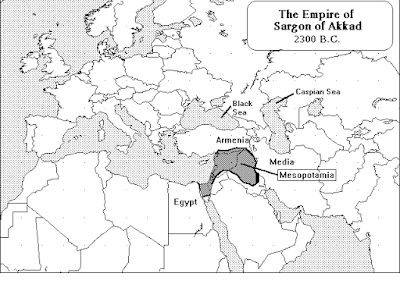
The rise of cities allowed for the conception of empire. Sargon of Akkad was considered to be the world's first large empire builder in ancient civilization. What fallowed was a dangerous path to permanent conflict. Soon every continent would have large empires. Rome, Egypt, Nubia, Kush China, and Mesoamerican civilizations came into existence getting larger through conquest. While these empires of Africa, Asia, the Americas, and Europe were different they had one common trait. Imperial ambition and war were the foundations of these states. Ancient imperialism denied many people freedom if they had the misfortune of being conquered. There were cases in which areas would just merely have to pay tribute rather than face complete subjugation. The Roman Empire had to do this to a degree to prevent mass insurrection. Particular negotiations had to be conducted to maintain vast amounts of territory. Ancient imperialism functioned around a city growing or region in power and then expanding beyond certain borders. A series of wars would be fought till it reached an immense geographic size. Decline would follow from either military defeat, internal political problems, or being conquered by a stronger power. The Mauryan Empire fell into gradual decline after Emperor Ashoka. The Roman Empire split into a eastern and western section. Rome faced attacks from Lombards, Goths, Visigoths, and various Germanic tribes contributing to its decline.

Warfare was not seen a something negative, rather a common part of state affairs. This did not mean that peace was completely rejected when an empire reached its apex. Such projects required a level of collaboration and powerful leaders. The ancient imperial projects could only function under a monarchy or emperor as the governing authority. Monarchy has been the oldest form of government. Democracy can trace its origins to Athens around 508 B.C.E being more direct in political function. All citizens had the right to come and address the Assembly. This was not truly rule by the people rather the nobles had control through their own council known as Areopagus. Athens was a city-state in classical Greece that was a rare exception. All over the world there were empires located near river systems governed by monarchs along with a ruling class. If such democratic systems been in place, ancient empire may not have expanded in the way that they did. The ancient and classical empires did leave behind impressive structures, ideas, and knowledge yet it should be understood it came at a cost. The progress that scholars cite came at the expense of the lower classes and subject peoples.

Empire building began to spread across the globe with numerous states appearing in Africa, Asia, and South America. There has been a common conviction among scholars of history that empire works seeing as it is a consistent theme that appears in world history. The British Empire has been discussed with nostalgic endearment. This emotion ignores that it was at least until World War II the most oppressive force in the international landscape. Contrary to popular belief empire and imperialism are not sustainable systems. They brought much violence, disorder, and fear to the victims of an empire's might. While the process was violent, at times it required collaboration from subject peoples. The Roman Empire would not have lasted long if it did not have willing cooperation from other groups that it conquered. The British Empire used a method of indirect rule with some of its colonies. India was a colony that required alliances with local leaders to assist British control of a vast subcontinent. Such control mechanisms require that particular groups are in confrontation with one another so they cannot united to free themselves from an empire. Belgians did this in Rwanda and the Congo realizing that Hutu and Tutsi conflict would work to their advantage. While empires can be oppressive to numerous ethnic groups or the entire population chaos follows with collapse. New states emerge and old hostilities carry over. The end of the Roman Empire gave rise to numerous tribes that attacked it to change the political landscape. What emerged was the Byzantine Empire and the Holy Roman Empire, which were successors to Rome. Europe was in a period of the Dark Ages in which there was little advancement in the arts, sciences, or culture. African and Asian civilizations were not experiencing in their societies. As time passed, the European empire gained an advantage in science and technology. The Enlightenment and the Age of Exploration propelled Europe into a leading position among the nations of Earth.
 |
| The territories of the British Empire are in pink. This was the extent of its influence that ranged from Africa to Asia and areas in North America. |
There will always be conflict when empire emerges. The British, French, Germans, and Italians competed for colonies and influence around the world. Spain and Portugal were the main competitors in global influence during the Age of Exploration. These two powers were later surpassed by France and the UK. During the 19th century Germany and Italy became unified states changing the balance of power in Europe. It was only a matter of time before mass global conflict broke out. World War I lasted from 1914 to 1918 leaving Europe devastated and new countries forming out of that conflict. There was not satisfaction or clam, rather more political complexities in eastern and central Europe. Britain and France divided new territories among themselves under the mandate system. The collapse of the Austro-Hungarian, German, Russian, and Ottoman Empire caused a mixture of ethnic violence and confusion. The modern Turkish state made it clear that Greeks, Armenians, Kurds, and Jews were not going to be part of the national project. What drove empire was economic and political factors. It was a lucrative enterprise and it created a sense of unity among the mother countries. When empire collapses, there still remains the practice of international power politics in which various states compete with each other for economic,political, and cultural influence of the world. Neocolonialism is merely the product of a lost era in which certain nations could be aggressive and dominate countries which could not resist. The idea that empire works seems to lack cogency, considering the number of empires that have disappeared or have left instability in multiple regions of the globe.
The persistence of warfare around the world demonstrates that humanity has not made progress. Warfare may have even been part of early hunter-gatherer societies and became more a common activity with the rise of property ownership as well as permanent settlement. When the idea of permanent states developed along with more centralized governments, armies were needed to defend borders. Conflict was inevitable with these historical developments. The building of empires was not a peaceful activity. It involved subjugation of various people by armed violence. They only way this was kept under control was through international law and a modern system of treaties. Prior to World War I, there were the Hague Conventions building the groundwork for modern international law, rules of warfare, and early system of supranationalism. After the Great War, the League of Nations was formed as an international body to promote peace and enforce international law. This body was not able to deal with the British Empire and France in regards to their abuses under the mandate system. It was unable to thwart the growing threat of Fascism or a more aggressive Japanese Empire. Low scale conflict finally merged into a larger one by 1939. With the defeat of Fascism in World War II the United Nations was formed to ensure that mass global conflict would never happen. However, conflict did not stop. The Cold War and decolonization became major sources of discord. The Korean War, the Vietnam War, and the Israeli-Palestinian conflict were causing much humanitarian crisis and erratic changes in both Asia as will as the Middle East. France and Britain were still unwilling to give their colonies independence and some had to get their freedom by armed force. Burma, Algeria, Vietnam, Zimbabwe, and South Africa had to fight armed struggles to remove their former imperial masters. The South African region was in long term conflict from the Rhodesian Bush War to the anti-apartheid armed struggle. When all these decolonization movements were occurring, the US and Russia were engaging in wars of proxy with one another getting more involved in the Third World. Wars were happening all over the globe in the 20th century and will still continue. The end of the Cold War did not bring lasting peace or stability. It formed a world in which US power when unchecked. Nations were subject to the whims of US power, but it seems that multipolarity is challenging that concept. The potential for conflict grows greater with Russia and China as long as US foreign policy attempts to antagonize these countries.

The world powers need a system of peace for the sake of security. Yet, there remains too much profit in warfare. The military industrial complex has become an essential part of the economies of France, the US, UK, and Germany. Arms manufacturers have significant investment in seeing global conflicts continue. There may also be a more lugubrious reality in which the majority does not want peace. The democratic western societies have attacked states in the developing world. The arguments used are either based on humanitarian intervention or a national security measure. These states have smaller armed, no nuclear arsenals, and have less wealth yet are presented as dangerous threats. Iran and North Korea could not defeat America, France, or the UK in armed conflict. The motivations are different than what the citizens of the developed nations are thought to believe. War provides a perfect distraction from domestic problems such as economic weakness, crime, or corruption in the political system. During times of war, the public is more united in fighting a common enemy. When politicians of the liberal democracies have failed to provide solutions to growing domestic challenges, there is an attempt to scapegoat a particular group or people. Despite the political conditions of a certain era, warfare has been a reoccurring part of human history. Many cultures and people around the world have had a tradition of warrior societies. Dahomey, Japan, and Sparta are a few examples of strict and regimented warrior cultures. As long as states and governments exist, there will be no peace on Earth. Humanity has a bullying and violent nature that has yet to be overcome. The reason why the peace movement or pacifism in general will not become a large force is that is against the public's instincts to support such ideas. The only time people en mass repudiate war is when their country begins to lose. When there is nothing but triumph, then nationalist fervor cannot be contained. Ethical questions are not as important as strategic ones. Warfare has throughout history been an instrument to gain or expand power. Warfare's intrusion into multiple regions only makes the situation more precarious making it easier for conflicts to merge.
The myth of human progress also can be seen in the idea that this is a more tolerant era. Racism, sexism, class conflict, religious persecution, and homophobia as some claim is not as awful as it was in the past. While this is a statement of fact, that does not mean these ills have disappeared. There are certain cases in which as been on the rise in response to economic and political factors.Besides current developments, prejudice can be present in societies for long periods of time. The contemporary era shows that people have more contact with various cultures, races, and religions yet this does not terminate extreme ethnic conflict. This does not prevent discrimination or persecution in nations around the globe. China continues to treats its Tibetan and Uyighur population as second class citizens. The United States not only is going through a phase in which white supremacy is seen as acceptable, other groups are targeted. Islamophobia and anti-immigrant sentiment has been spreading on both side of the Atlantic. Russia has undergone a nationalist revival in response to a NATO build up. As a result non-Slavic peoples are viewed with suspicion. All around the world there seems to be ethnic conflict or some for of racism or persecution. The threat of genocide become more a possibility under a world in constant warfare. Xenophobic nativist nationalism has become a popular movement among the far-right and politicians in power to remake their nations into a homogeneous unit. The idea that globalization brings about tolerance or a greater understanding seems misguided. To an extent it enables cultural imperialism. Western culture has become more accessible and attractive to youth of the developing world. With its ubiquitous nature, the local culture seems to be either eroded or will be phased out as time goes by. There is not merely acculturation. There is a desire to have all nations westernize and simultaneously abandon what makes them culturally distinct. Such ideas are promoted by supporters of supranationalism and a globalist political philosophy. The hidden ethnocentrism of the countries of Europe are demonstrated in their behavior relative to foreign policy. They blame a country's lack of development on the fact they do not westernize. Ignoring the legacy of empire or the impact of neocolonialism only shows that racist ideology has not dissipated.

More and more the people of the world have become extremely tribal in their thinking. Economic and social tensions are only exacerbating intolerance. Fear of demographic shift has driven voters in democratic societies to vote for people with authoritarian tendencies. Hatred does not just involve skin color it also includes political affiliation or culture. Religious fundamentalism continues to exist even when people live in a society of science in technology. Fanatic Christians, Muslims, and Jews justify their abuse or violence against people on the basis of their religion. Zionism and Islamism have generated both religious and ethnic hatred in the Middle East. The Christian right in the United States actively undermines women's reproductive rights. Organized religion and its hold over large numbers of people is not a sign of progress. There have been multiple times in history in which religious fanatics were involved in persecution or elimination of individuals who dared question the Church. If it were not for the Enlightenment, such behavior and legal codes would have continued. Extremists of this sort are so intolerant other religions they see as illegitimate. With wider conflicts occurring across the Asian and African continent, the world is far from being tolerant. If there was to be substantial change, attitudes must be altered. Tolerance may not be enough. Acceptance should be the goal with the understanding that different groups of people have the same rights and deserve equal treatment. Many observers have made the argument that under democratic political systems, such ills of hatred and prejudice can be countered.
Liberal democracy or capitalism cannot be considered a measure of progress. Although state formation and building a political structure has always been an experiment it has not resulted in better lives for the people living in such states. This is not to say that an authoritarian or totalitarian government is a reasonable alternative. Communism attempted to challenge the capitalist system and there remains some active socialist organizations. However, it has not become a major political force. The only attribute about liberal democracy and capitalism is it can survive. Other than that, it cannot meet the needs of the people. The illusion of freedom is that people have a choice in such political structures. The pyramid structure that has existed since civilization's origins still negates the powerless majority. Voting or non-conventional participation can only do so much to negate the power of a ruling class. Corporations, lobby groups, and political action committees have more influence over elected officials than the average voter. The parliamentary and presidential systems could potentially fail by not addressing growing income inequality and the destabilization brought about by neoliberal capitalist policy. Democracy has a flawed system. It requires that all citizens participate, have equal access to that system, and that they have the ability to make informed decisions. The governments and citizens of the UK, France, Germany, and the United States fail to meet these requirements, which explain the current turmoil seen in those countries. There are nations that may have the structures of democratic government, yet behave in an authoritarian manner. Having the presence of multiple parties does not ensure a fair political system or an efficient one.

India and Pakistan have to struggle navigating a multiparty system combined with both regional and ethnic complications. The end of the 20th century did not usher in an era of greater human freedom, rather a system of illiberal democracy. The oldest form of government was monarchy . That system was dominant up until the late 19th century to early 20th century. From the ancient world up to the early 20th century a political scientist may have believed that monarchy would be the only political system that humanity would adopt. An assumption like that would be incorrect. Certain political systems have not been experiment with. New ideologies emerge challenging the political consensus and order. There has been the possibility of revolution that will dramatically change the cultural and political environment of a nation. Liberal democracy is nothing more than another political experiment that will not last forever. By nature it can be unstable and erratic. Capitalism puts emphasis on free markets and private enterprise. Supporters claim it can create prosperity and reduce poverty. It does create prosperity, yet not for the whole of the population. The ruling elite benefit the most while labor is exploited for the sole purpose of profit maximization. The developed world has witness a phenomenon of stagnant wages, fiscal austerity, and even longer working hours. The middle class and poor are forced to pay more in taxes in a supply side economic system, which has created growing tension. There are very few foundations for personal economic security. There can be a chance that a person could fall into poverty by no fault of their own. Economic and political systems should not be used as an indication of human advancement. No matter what political or economic model poverty and war still persist.
Science and its application has often been referenced as evidence of human progress. Applied science has produced many marvels. Biomedical and health science has combated disease as well as increased average life expectancy. The telephone and the internet make communication around the world far more simple. Space exploration opens up doors to places never thought to exist. Technology has to an extent improved lives. It can be abused depending on how it is utilized. Nuclear weapons and their proliferation cause concern. The trepidation comes from the chance humanity's destruction will come at its own error.

This was not the only technological advancement that shocked the world. Airplanes, tanks, and drones changed centuries of military tactics with their introduction. Warfare became more lethal. Technology and science have been viewed with a level of caution and fear. The unintended consequence of technological development was harm to the environment. Pollution, the burning of coal, and masses of waste have cause permanent damage to the Earth. The world's population grows and the more it consumes. Electronic and plastic wage has become harder to dispose of. Climate change also poses a threat to the safety of the world population. Higher carbon dioxide levels from fossil fuel use and automobile transportation exacerbate green house effect. The increased temperature causes the polar ice caps to melt gradually. The sea levels rise increasing the likelihood of flooding. The Earth's climate has changed throughout geological history, but this is the first time in which people contributed to this rapid shift. The industrial revolution transformed the environment of the world. Factories and machine power would soon replace manual labor. The world became more reliant on fossil fuels such as coal and oil. This desire for and intense consumption of fossil fuels devastated both land and sea. Besides what humanity has done to its environment, it is may be doing something similar with the body. Genetic engineering and transhumanism are no longer science fiction. Last year the fist gene edited babies were born and it is not unheard of to seeing genetically modified organisms in supermarkets. Human beings have the ability to alter themselves biologically. If there is limited regulation or laws regarding this new scientific knowledge could be misused. Information technology has become a part of daily life. So much so, that privacy may be a relic of the past. Data protection and identity theft are becoming large concerns on social media platforms. The collection of data and surveillance by either governments or corporations violates privacy and civil liberties. Science and technology will continue to evolve, however it is pivotal that it must be used responsibly. Technology did not make the human condition easier; it may have added more issues.
Human history has reached a stage in which more people live in cities, use technology, and live under some version of liberal democracy. There is the tendency to say that the current period is much better compared to the past. Progress has in this perspective a logical conclusion. The definition used in this context means that society and the human condition can improve for the better. The myth of human progress is that someday civilization will reach a level in which war, poverty, and oppression disappear. This utopian ideal does not acknowledge that history does not follow a direct line of advancement. Large empires and states have appear then vanished leaving behind artifacts of their golden age. There could be social, political, and economic progression yet this could all be eradicated with a change in regime or circumstance. The African, South American, and Asian nations have long histories of civilizations and empires. When the industrial revolution and the advances in modern science passed them by, they became colonized. Ethiopia and Japan managed to avoid this fate by making efforts to modernize and build an industrial capacity. The former colonized countries are now trying to reach a level prior to European contact. The march of humankind seems to be a never ending struggle. There are cycles and parallels of both improvement then reversal. Civilization could completely collapse if pressing global issues are not addressed. A permanent state of warfare, climate change, and societal upheaval could eradicate the world's population. Making these assessments is not an embrace of a cynical world view. Having realistic proposals and strategies will allow for an actual solution to current and future challenges. As long as the myth of human progress continues to dominate international affairs circles and the general public, humanity will be trapped repeating the same mistakes.
Further Reading
Harari, Yuval. Sapiens A Brief History of Humankind. New York : Harper Collins, 2015.
Wright, Thomas. Technology. Tinley Park IL : Good-Willcox Company, 2008.
Woolf, Alex. A History of the World. London : Arcturus, 2016.
Wednesday, January 23, 2019
Venezuelan Protests
There have been protests occurring in Venezuela against the government of Nicholas Maduro. Since the death of Hugo Chavez, the country has been struggling economically. This does not mean that President Maduro has lost all support. There are suspicions that there are external influences exacerbating internal challenges in regards to rising food and fuel prices. The Trump administration has stated that it wants to see another form of government in Venezuela. Prior to this the Maduro presidency claimed that it was victim of an attempted drone attack by the US. It would not be surprising that there is another plan for regime change in Venezuela. Such a plan was was attempted in 2002 under the Bush administration. Even more bizarre was Juan Guaido declaring himself interim president. So far, The US and Guatemala recognize him as the legitimate leader of the country. This seem ludicrous when Maduro won the election and has not been removed from office or resigned. The US intends to add more sanctions to a country already struggling. Leftist governments are under attack in Latin America by far-right resurgence with US support. Brazil was the testing ground and it is possible Bolivia will be another target. There is a fear that the country may even fall into a state of civil war if escalation continues. Mainstream media was to present the Maduro government as authoritarian and oppressive, when Guaido has the backing of big business and foreign entities. France 24 did not mention the pro-Maduro rallies and their confrontation with the opposition. The situation is far more complex than a leader versus the people. Venezuela represents the challenges of creating a stable socialist government, being too reliant on a single natural resource, and the legacy of US imperialism in Latin America.
Sunday, January 13, 2019
The Democratic Republic of the Congo's New Leader Felix Tshisekedi
President Joseph Kabila shocked African political observers, when he announced he was not seeking re-election. He has been the president of the Democratic Republic of the Congo since 2001 and this is sure to be a major change in the country. It appears as if this decision may be influenced by events in Togo, Sudan, Zimbabwe, and Burundi. A number of African sates are removing long time leaders. The newly elected leader Felix Tshisekedi in this interview explains what his political vision is and what he hopes to do for the DRC. President Tshisekedi recognizes that poverty has cause much discord through the nation. Lack of security and violence has caused internally displaced persons. He accuses the Kabila presidency of this division, but the reality is it is a complex web of ethnic conflict and external Africa states causing disturbances. Corruption, poor governance, and semi-authoritarian rule can not be easily overturned with the election of a new president. The DRC has a long way to go in terms of recovery from the Congolese Civil War of 1998 to 2003. The question remains what to do about armed groups and rival factions. The M23 rebels caused disturbances before and there is a possibility new groups could emerge. Peace must come, before economic development. As long as the country remains dangerous, investment or infrastructure projects will not be possible. President Felix Tshisekedi will have many problems to confront and it is unclear what specific policy can solve them.
Wednesday, January 2, 2019
Calls For Omar Bashir To Resign
Tuesday, November 20, 2018
Why US-Russia Relations Will Not Improve
The Donald Trump administration has taken a different approach in its tactics with Russia. Even with the revelation of of Russian interference in the US 2016 presidential election, the administration wants improvement in relations. Such actions have caused feelings of anger and confusion. There have been condemnations of Donald Trump meeting with Vladmir Putin, but this should not be taken as an act of treason. Nor should it be seen as a skillful work of diplomacy. While it seems that the Trump administration is interested in improving relations this seems unlikely to occur. The current geopolitical and historical circumstances prevent such a substantive change from being enacted. The Cold War may be over, yet the legacy still haunts both nations. The Russian Federation and the United States continue to perceive each other as enemies. The past continues to effect the present as represented by the behavior of both countries. The US and Russia have a radically different world view and this is apparent on certain matters of international affairs. Syria, Ukraine, and North Korea are areas of major disagreement and tension. The US continues to support NATO and maintain a military presence in eastern Europe. These maneuvers have only cause more complications in Europe and around the world. Something must be done to prevent a large scale conflict from erupting. It is pivotal that the world's most powerful nuclear armed nations be in a state of peace and negotiation. Instead there are wars of proxy being waged in which the US and Russia are supporting various armed groups. Realizing such behavior is dangerous, means that there needs to be a reevaluation of US foreign policy, Regime change, nation building, and installing American modeled democracy has caused international instability. Through out the 20th century Russian and American contacts have been mostly negative. Donald Trump's pragmatism may be motivated by economic investment, attempting to isolate China, or a settlement on the Syrian conflict. The problem with this is that President Vladimir Putin would not trust the United States, after what had transpired during the Obama administration. While it would be welcomed that both nations reach a consensus, it is an unrealistic objective, given the current international situation.
The origins of US and Russian enmity began with World War I. When the Russian Revolution occurred, the decision was made with the new leadership to make a separate peace with the Central Powers. The October Revolution brought the Bolsheviks to power causing the collapse of the Kerensky government. The Allies were alarmed at these turn of events and fearful that this could be a help to Germany. The closure of one war front would have helped the German Empire, if it had occurred sooner. Between the years of 1917 and 1918 the Central Powers were facing eminent defeat. Western Europe and America were hostile to the new Bolshevik state, fearing world revolution. Vladmir Lenin had the intention of spreading a workers' revolution internationally deposing the capitalist world order and establishing it with a socialist one. The world was clearly being remade with the collapse of the German, Russian, Austro-Hungarian, and Ottoman empires. There was much trepidation about what the new geopolitical order would be. Russia was experiencing many setbacks with a limitation of munitions, supplies, and various defeats. Peasants grew more restless and workers could no longer tolerate conditions in the factories. Cazar Nicholas II was deposed unable to keep his empire functional. The Alexander Kerensky and Menshevik faction made the error of keeping Russia in the war. The Allies once concerned seemed to briefly rejoice at this decision. When Lenin came to power it was obvious to him there was no reason to continue combat with the Allies. The Brest-Litovsk treaty was signed in March of 1918.


The origins of US and Russian enmity began with World War I. When the Russian Revolution occurred, the decision was made with the new leadership to make a separate peace with the Central Powers. The October Revolution brought the Bolsheviks to power causing the collapse of the Kerensky government. The Allies were alarmed at these turn of events and fearful that this could be a help to Germany. The closure of one war front would have helped the German Empire, if it had occurred sooner. Between the years of 1917 and 1918 the Central Powers were facing eminent defeat. Western Europe and America were hostile to the new Bolshevik state, fearing world revolution. Vladmir Lenin had the intention of spreading a workers' revolution internationally deposing the capitalist world order and establishing it with a socialist one. The world was clearly being remade with the collapse of the German, Russian, Austro-Hungarian, and Ottoman empires. There was much trepidation about what the new geopolitical order would be. Russia was experiencing many setbacks with a limitation of munitions, supplies, and various defeats. Peasants grew more restless and workers could no longer tolerate conditions in the factories. Cazar Nicholas II was deposed unable to keep his empire functional. The Alexander Kerensky and Menshevik faction made the error of keeping Russia in the war. The Allies once concerned seemed to briefly rejoice at this decision. When Lenin came to power it was obvious to him there was no reason to continue combat with the Allies. The Brest-Litovsk treaty was signed in March of 1918.

The Russians lost territory to the Central Powers. The stipulations of the treaty included that Poland, Lithuania, and the Latvian province of Courland be given to Austria and Germany. Finland, Estonia and parts of Ukraine were to be made independent under German supervision. Livonia a Latvian province would also be a German protectorate. Turkey wanted access to the Armenian districts south of the Caucasus. Romania realizing it was isolated also sued for peace and in return was promised Bessarabia. The result was that the eastern front collapsed for the Allies. Germany could now devote its attention to the western front and Austria could focus on Italy. The Allies did not forget about Russian withdraw from the war. This resentment may have been an explanation for the intervention in the Russian Civil War. The Whites were a mixture anti-Bolshevik socialists, liberals, supporters of the monarchy, nationalist separatists, and some peasants. The US, Great Britain, France, and Japan sent troops to assist the Whites in their attempt to overthrow Lenin's government. The Communists won the civil war by 1920. Japan was the last Allied nation to withdraw its troops from the intervention. The series of events that occurred between 1914 to 1920 established the tone in which relations with Russia and the West would be. Russia since the reign of Peter the Great was seen as a dangerous rival power in Europe. The British Empire saw Russia as a threat to its position in South Asia. The Great Game was the term used to refer to British and Russian competition in the Central Asian region during the 19th century. Afghanistan became caught up in this contest. This competition was continuing mainly due to Britain's desire to the empire's Indian colony be at risk. This was why the alliance between the Britain, France, and Russia seemed peculiar. There could have been poor relations between Russia and other Allied powers, doubtless of what government was in power.

Foreign relations would antagonistic during the Interwar period. The United States just like the western European countries would view Russia and socialism with suspicion. America became so paranoid of Communist revolution that in 1919 there was the Red Scare. A combination of xenophobia and fear of Bolsheviks erupted in racist violence and government oppression. A mysterious series of mail bombs were sent through out the country. It was unclear if it was a group or even Communists that were the culprits. It provided Attorney General A. Mitchell Palmer a justification to arrest and deport foreigners. One mail bomb was sent to Palmer's home giving him an excuse to abuse power in the name of public safety.The people who were arrested were 5,000 in total and it resulted in 249 deportations. J. Edgar Hoover a member of the Justice Department was an assistant to Palmer who would later become a long serving director of the FBI. Hoover would use the same tactics he learned during the Palmer Raids during the second Red Scare in the 1950s. The Red Scare of 1919 would end in 1920. Palmer and Hoover created mass hysteria while making outrageous claims about attempted Communist takeover. Thus began America's association between socialism and violence. Americans began to view Russia as an enemy to freedom and to an extreme degree a threat to world peace. The irrational obsession with Russia did not allow other European countries to see real dangers. World War I and the Versailles Treaty created a situation in which Fascism could flourish.
The United States after the war chose a policy of isolation relative to European affairs. The Soviet Union was going through a massive transformation. Joseph Stalin became the absolute ruler and master of Russia. However, his ambitions were not world revolution rather revolution in one country. The Soviet Union was not going to embark on major international revolutionary movements as Lenin had envisioned. The plan was to engage in programs of industrialization and collectivization creating a model socialist state that could compete with western powers economically. I would seem that that would have been impossible considering the global economy during the 1920s was experiencing growth. Roaring Twenties America was a place of growing consumer culture economic power, and wealth. Many erroneous thought that such prosperity would last indefinitely. The stock market crashed in the United States effecting European economies. The Great Depression caused unemployment and homelessness. Communism and socialist ideology was becoming more attractive to people , which caused trepidation in European and American political circles. This explains why Fascism was seen as less of a threat than Communist revolution. Perturbed and confused by economic and political crisis the German and Italian people turned to extreme far-right political parties. Adolf Hitler and Benito Mussolini would attempt to remake the European political order. Germany and Italy had larger ambitions for expansion. France and the British Empire appeased them for a number of reasons. It was the a belief that if these two powers were not a force in Europe the Soviet Union would become more powerful. Both France and the British Empire did not want to fight another war.

Fascism was seen a the only way to counter totalitarian Stalinist Communism. These positions were horrible miscalculations. The failure to establish closer relations with the Soviet Union in the 1930s allowed Germany to maneuver in manner to expand. Joseph Stalin accepted a non-aggression pact with Nazi Germany shocking the world. Some in liberal and socialist circles thought of it as a portrayal. Germany was free from fighting a two front war for the time being. A secret part of the agreement was that Poland was going to be divided between both Nazi Germany and the Soviet Union. The West only became more anxious as Germany had masterfully deceived both France and the British Empire. When Germany invaded Poland, France and Britain had to go to war to preserve Poland's independence, which was part of their security agreement. World War II began with the Axis powers gain vast amounts of territory. The US continued to remain out of the conflict, but it was inevitable that it would get involved. Although America proclaimed neutrality, it was aiding the British through Lend Lease Act. This program of aid was expanded to include the Soviet Union, China, and other Allies in the war against Fascism. Two events that altered the war were Germany's invasion of the Soviet Union and Japan's attack on America at the Pearl Harbor base. Hitler initiated a two front war, terrorizing the Russian population. Russians suffered immensely compared to other Allied nations. The invasion and conquest of France in 1940 left Great Britain the only country fighting the Axis powers, but this was soon reversed by events in the Pacific and Hitler's desire to destroy Communism. Thus, the British Empire, the United States, and the Soviet Union became unwilling partners in the war. Stalin complained that the US and Britain should open a second front so that the war could come to an end. Prime Minister Winston Churchill had anxiety about such an operation recalling the failure of Gallipoli during World War I. Rumors began to emerge that the US and Britain were delaying this military operation to leave the Soviet Union in a weakened state so it would not have global influence in the post-war era.

Eventually, it was decided that an invasion would happen in Normandy, France. Axis power had been slowly declining since 1942 and the days of rapid victories were coming to an end. D-Day occurred on June 6, 1944, while the Soviets were pushing from the East. Germany would surrender May 7, 1945. The world had been radically changed, more so than after World War I. Great Britain would no longer be the most powerful nation on Earth. The United States of America and the Union of the Soviet Socialist Republics would become the world two only superpowers. Both countries became antagonistic toward one another fighting for geopolitical dominance. Relations between the US and Russia were in poor condition prior to the war due to the political circumstances in the international landscape. The new peril came from the rise of nuclear weapons. Two large super powers were amassing arsenals and the fear of nuclear war would occurred caused panic. Europe became divided between east and west with an Iron Curtain acting as a barrier.
American and Russian rivalry became more intense during the Cold War. Both nations were influenced by popular myths in regards to their ideology. America though it was a defender of the free world and that Communism was such a danger it must be contained or eliminated. Russia thought it was leading an international freedom struggle against capitalist oppression. The US and the USSR were merely doing what other world powers had done before them: partitioning geopolitical space. The Soviet Union could have a long term presence in Eastern Europe and the Baltic states. The United States would embark in a new global role deposing governments, stopping anti-colonial movements, and promoting American business interests. The Soviet Union would in response to the US military interventions was to support various anti-colonial movements and even aid leaders of the non-aligned movement. The US and Soviet Union would fight wars of proxy in the Third World. There are numerous reasons the Cold War began. The break down of the wartime alliance created the atmosphere of mistrust. The power void left by the defeat of Germany, Italy, and Japan only made matters worse with both the US and USSR trying to influence areas in Asia, Africa, and Latin America. Civil wars in China and Greece were some of the first areas in which the US and Russia became involved with. There was also a major economic incentive for the United States. Europe was at the time a large consumer of American goods. If the Soviet Union had more influence on the European continent, America would have been at a disadvantage in trade. US farmers, automobile companies, steel, and machine tool companies needed stable European markets.

There was a resistance to open dialogue and diplomacy after World War II. The US and USSR became constant competitors for world power. President Harry S. Truman promoted a policy of containment. The Truman Doctrine stated that aid and assistance should be given to peoples who are threatened by Communism. The Truman administration aided both Greece and Turkey to demonstrate to the Soviet Union that the US had the resolve to challenge them anywhere. The year 1947 saw the Cold War escalate to new levels. Mao's triumph in China caused more frustration in the US and conflict in Korea broke out in 1950. The West and East only became more hostile to one another with the establishment of new military alliances. NATO was created in the event of Russian aggression and the Warsaw Pact was developed to counter the West. Simultaneously, the US was getting more involved in Southeast Asia. Vietnam became a place in which the containment policy failed,because US officials did not understand the nature of the situation. The Vietnamese were fighting to have their nation free from imperial rule. The Viet Cong and Ho Chi Minh were seen as puppets of Moscow by the US government. From the Dwight Eisenhower to Kennedy administration there were no attempts to distinguish between freedom struggles and Soviet subversion. There was hope with a more liberal president that relations could be improved with Russia. President John F. Kennedy made such an attempt with Premier Nikita Khruschev. The Vienna summit did not produce results. Conditions became even more dire. The Berlin Wall was constructed creating tension that had not been seen since the Berlin blockade. Through espionage, the US discovered that the Soviet Union was building nuclear installations in Cuba.


The Kennedy Doctrine made it clear that no Communist government would be allowed to be in the western hemisphere, especially in the South American countries. The Bay of Pigs invasion was a failed military intervention with the goal of deposing Fidel Castro. Cuba allowed nuclear weapons and sites on the island only after this attack. The nuclear sites were to act as a deterrent against possible US invasion, but instead it caused the world to be on the brink of nuclear war in 1962. Nuclear brinkmanship had brought the world to a state of crisis and the world wondering what might happen. Both leaders reached an agreement with Russia removing its nuclear missiles from Cuba and the US dismantling its sites in Turkey. For the first time since the end of the war, the two countries were engaging in rational diplomacy. The successors of Kennedy and Khruschev did not follow what could have been a path to peaceful coexistence. Vietnam became a source of tension between the Soviet Union and the United States. President Lyndon B. Johnson escalated involvement in the region continuing to send more troops with the Gulf of Tonkin resolution. General Secretary Leonid Brezhnev reversed much of Khruschev's reforms and foreign policy measures. The Americans supported the authoritarian regimes in South Vietnam, while the Russians as well as Chinese supported North Vietnam. The image of America was slowly declining in international public opinion as the war was seem as an imperial conquest in the Third World and certain western political circles. The Vietnam War so badly damaged the Johnson presidency, he did not seek re-election. The US would take another turn to the right with the rise of Richard M. Nixon. Along with Secretary of State Henry Kissenger a new policy of detente with the Soviet Union was formed. Political and military tensions were to be eased with the Soviet Union. Doing so, Richard M. Nixon hoped an honorable peace and a victory in Vietnam by exploiting the Sino-Soviet Split. Tensions between Russia and China had worsened to such a degree that there was a border clash in 1969. Mao Zedong disagreed with Khruschev's policy of destalinization creating antagonism among the two Communist states. Rapprochement did not occur with the change in leadership in the USSR in 1964. The result of detente policy was SALT 1 and SALT 2. The Strategic Arms Limitation Treaties called for the reduction of nuclear weapons. The Ford administration continued the detente policy, but political direction was shifted once more with the Jimmy Carter presidency. The Soviet invasion of Afghanistan ended the thaw in US-Russia relations. This action made the US congress to reject ratification of the SALT 2 treaty. The Soviet Union wanted to ensure that the socialist People's Democratic Party of Afghanistan remained in power. Afghanistan was struggling with a series of coups since the fall of King Zahir in 1973. Instability tended to attract external powers interested in gaining influence. Sensing that this could be an issue for the Soviet Union National Security Adviser Zbigniew Brzezinski suggested to President Jimmy Carter that the US should arm and assist growing radical political Isamist groups to undermine the PDPA. The reason why the US became more involved in Afghanistan was not only for geopolitical reasons, but to get vengeance on the Soviet Union for its role in Vietnam. The Soviet-Afghan War lasted from 1979 to 1989 and was in many regards a Russian version of the Vietnam War. The Ronald Reagan administration came to Washington with a policy of aggressive anti-Communism. The military was built up more so, while a new arms race was happening. Relations once more reached a nadir. Ronald Reagan infamously referred to the Soviet Union as " the evil empire." A speech made in 1983, this speech was designed to demonstrate that the US was more willing to get aggressive with Russia. Presidents had never been this threatening when discussing the behavior of the Soviet Union. A new era had began, with growing concern about US-Russia tensions.
The death of Leonid Brezhnev exposed that Russia was facing a number of economic and political challenges. Corruption became widespread in the Soviet Government and the economy was stagnant. Brezhnev left no clear successor and the leadership was aging. The following leaders between the years of 1982 and 1985 died in office. Yuri Andropov and Konstantin Chernenko did not formulate new policies to address tensions with the US or domestic problems. Real change did not come until Mikhail Gorbachev came to power. However, it seemed that reforms would be too late. the Mujahadden were still fighting the Red Army in Afghanistan and the arms race with the US was continuing. There was a demand for change in terms of relations and foreign policy. The 1985 Geneva summit meeting both Reagan and Gorbachev came to the conclusion that strategic nuclear weapons must be reduced for the sake of global security. Nuclear weapons were no longer just solely devices of the US and USSR; they were spreading. Other nations such as Pakistan and North Korea were seeking them. Since 1982, the Reagan administration was engaging in the Strategic Arms Limitation Talks, but aggressive anti-Communist rhetoric blocked progress.

There was the 1986 Reykjavik meeting which came close to genuine arms reduction. The problem was that the United States was unwilling to abandon the Strategic Defense Initiative. This program was directed at the Soviet Union with the proposal of using space based weaponry to intercept Russian nuclear missiles. The two leaders did accomplish something. The Intermediate-range Nuclear Forces Treaty was signed in 1987. All land based intermediate -range nuclear missiles were banned from Europe. Soviet SS-20s were removed and no longer directed at western Europe. NATO no longer had missiles directed at Russia. The Soviet Union could no longer afford to remain in Eastern Europe or fight in Afghanistan. The fall of the Berlin Wall represented the end of the Cold War and the most negative chapter in US-Russia relations. The Soviet Union would cease to exist when it dissolved in 1991. A myth that emerge was that Ronald Reagan's administration ended the Cold War. Western triumphalism was the new political philosophy in various circles proclaiming the superiority of capitalism and liberal democracy. Economic shock therapy which was done in Eastern Europe had negative effects on the population. Prosperity or new jobs did not come with the new free market systems. President Boris Yeltsin in the 1990s developed policies ending price controls and increase private ownership of industry. Free market reforms and the end of a social safety net caused many Russians to fall into poverty. While the Cold War had ended, the US still wanted to prevent a Russian rise. The error was that many assume since Russia adopted a capitalist system that relations would improve with the United States. Neoconservatives viewed Russia as a potential menace even though there was little chance of the Communist Party becoming the political force that it once was.

The US was enjoying a role as being the world's sole superpower and policy became devoted to stopping the rise of rivals. NATO was struggling to define what its role was in a post-Cold War world. Russia was promised that the alliance would not expand. However, NATO became involved in both Yugoslavia and Afghanistan. Russia was having too many internal problems to adequately deal with rapidly changing international affairs. The United States did not have another power to check its behavior. When the US intervened in the developing world, it always had to make the consideration of how an equally strong power would react. Russia became during the Boris Yeltsin presidency in the separatist movement in Chechnya. A full scale invasion in 1999 was condemned by the international community. Russia viewed this as an internal matter regarding its territory. To the United States it conjured memories of the Cold War. Yeltsin resigned having no solution to the war with Chechnya or Russia's economic turmoil. The terrorist attacks on the World Trade Center and the Pentagon on September 11, 2001 dramatically altered the world. The US used the attacks as a justification for aggressive war. Iraq and Afghanistan became subject to attack from the United States tarnishing its image among allies and other nations of the globe. Russia going into the 20th century had a new vision of its place in the world. Vladmir Putin would rise as the most dominant force in Russian politics with the goal of increasing the country's international profile.
History demonstrates there are cases in which US-Russian relations can reach a consensus. Yet these are only temporary due to vast differences on perspectives relative to global affairs. Vladmir Putin does not want a revival of the Soviet Union, rather his political ideology is based on a Pan-slavic revival. He wants a strong Russia that can assert itself when it needs to. Vladmir Putin has a more pragmatic foreign policy, but it is not in alignment with other European leaders or the US objectives. It has changed and been revised since his first term. President Putin was willing to assist the United States in the War on Terror, yet was opposed to the invasion of Iraq. The Russian Federation like many other countries condemns US unilateral military action. Although Russia did not approve of the Iraq War, relations with the Bush administration were better compared to the Obama administration.


There was gradual deterioration in 2008. Conflict with Georgia gained international attention. When Georgia conducted a military operation to capture both South Ossentia and Abkhazia Russia responded with force. From 2008 onward, Russian and American diplomatic ties would be strained going through another vicious cycle. The Russian perspective was that this was a regional matter, that did not need to include international involvement. During Putin's first and second term Russian was finally on a new trajectory. The United Russia Party saw victory in parliamentary elections in 2007 giving Putin a new mandate. According to the constitution he could not run for another term and decided to step aside. Dmitry Medvedev became his successor, yet Putin was appointed Prime Minister still retaining a high amount of influence. The West became more critical of the issues related to media freedom and accusations of electoral fraud. International observers and the United States continue to question the legitimacy of Russia 's presidential and parliamentary elections. The Arab Spring uprising that occurred in North Africa and the Middle East further damaged Russia and US relations. Libya became a source of contention, when Russia voted for UN resolution 1973. Russia was convinced that regime change was not part of the proposal, but when rebel factions were being armed by the US, UK, and France there was a sense of betrayal. When Vladmir Putin won his third term in 2012 he was determined not to seen another Libya situation in Syria. Russian interest were too vital to see the Assad presidency collapse. Russia then decided to intervene in Syria in 2015 to fight ISIS and keep President Bashar Al-Assad in power. The US had funded opposition groups in Ukraine through USA Aid and by 2014 protests against President Vikor Yanukovych broke out. Russia was alarmed that there was US interference close to its borders. Russia responded with the annexation of Crimea and supporting pro-Russian separatist groups in eastern Ukraine. Vexed, the Russian Federation got involved in interference with the US presidential election of 2016. Unable to to hack into the RNC, Russia was able to get access to DNC data. This made many to question if the Donald Trump campaign was colluding with Russians. So far, the Robert Muller investigation has not detected evidence of treason or direct collusion. There does remain the possibility considering that President Donald Trump fired FBI James Comey. When examining the history of the United States and Russia it is clear that relations may not improve in the future.
President Donald Trump wants to improve relations with the Russian Federation, yet this does not seem feasible. Much of it is related to the completely different world views that both countries have. The US still functions on a neoconservative foreign policy with the intention of nation-building. The United States simply does not want to see the rise of a world of multipolarity. Disagreements over Ukraine and Syria will hinder any progress of talks. The questions regarding Iran and North Korea only complicate matters. The more aggressive position the US takes, the closer Russia and China become. Donald Trump's limited understanding of Russia and foreign affairs puts him at a disadvantage. When the president meets with his Russian counterpart, meetings will not be substantive or reach long lasting agreements. What happened starting with World War I through the Cold War still has an impact on the current condition of the US-Russia relationship. It was announced that the Trump administration was deciding to withdraw from the INF treaty. This could result in a new arms race between two world powers. The precarious situation only gets more exacerbated with the rise in Russophobia. The Democratic Party furious with its defeat in the 2016 presidential election needed a rational explanation for their loss. Hacking and Russian interference did not cause their defeat, rather the inability to adjust to a changing political climate. There were many voters in rural areas that were ignored and left behind due to globalization and uncontrolled neoliberal capitalism. The Democratic Party lost a huge cross section, which only aided Trump's rise in American politics. While Trump has constantly promised improved relations with Russia, but this is not attainable. Sanctions remain in place since they were placed in 2014. When the price of oil fell in that same year Russia was struggling economically. Enacting a sanctions measure was tantamount to a declaration of war. There was at some point optimism in Russia that a new Republican president would be willing to negotiate certain disputes. When Trump decided that US troops were not leaving Syria and a rumor that the US wants to establish a permanent military base in Poland much of the drive for improving diplomatic relations stalled. The United States of America and the Russian Federation are going down a path of possible military conflict. Relations can only improve if certain conditions are met. The US must accept that the world is moving to a multipolar political power structure. Russia should make should stop interfering in US elections or data systems. Syria and Ukraine should be allowed to decide their own political future without American or Russian involvement. Russia and the United States should develop a framework of peaceful coexistence. Ultimately these conditions may not be met in this century. As the Cold War demonstrates, the US and Russia have been through fluctuations of turbulence.
References
Hayes, Carlton. History of Europe Since 1500. New York : Macmillan Company, 1956.
William, Rana. American History. London : Parragon Publishing, 1999.
Norton, Mary. A People And Nation A History of The United States.
New York : Houghton Mifflin Company, 2001.
Woof, Alex. A History of The World The Story of Mankind From Prehistory to the
Modern Day. London : Arctus, 2016.
Ewans, Martin. Afghanistan A New History. London : Curzon Press, 2001.
Thursday, November 1, 2018
Cameroon Election Puts The Nation In Crisis
Cameroon faces many challenges. The re-election of Paul Biya has created more political tension with opposition candidates attempting to contest the results.President Biya has been in power since 1982 and it appears there may be no end in sight to his long rule. What has emerged is an Anglophone based separatist movement, which he has used as a justification for strict measures. Simultaneously, Cameroon also with the assistance of Nigeria is at war with Boko Harem. Cameroon with such security challenges cannot maintain a functional democracy. The problem is that areas in which there is combat, it would not be safe to open polls. Then there is the issue of low voter turn out. If most citizens realize that the system cannot be overturned through democratic means, this may induce a civil war. There have been allegations of electoral fraud and intimidation in the elections for the presidency. Some may think that a violent overthrow would be the answer, but this would result in possible instability and conflicts between various borders. It may be that Paul Biya will be president for life and justify authoritarian policies a means for state security.Economically, Cameroon continues to struggle with poverty and lack of development. Paul Biya can always scapegoat the Anglophone separatist movement or Boko Harem for Cameroon's problems while deflecting questions about corruption and abuse of power.
Subscribe to:
Posts (Atom)